Back to Blog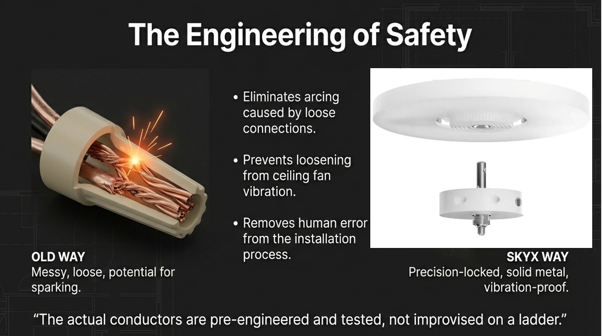
In Part 1, we talked about the problem: ladders, live wires, wire-nuts, and a century‑old installation method that keeps putting people in the hospital.
Now let’s talk about the solution: a ceiling system that’s engineered, standardized, and smart enough to make the old way look primitive.
What SKYX actually built
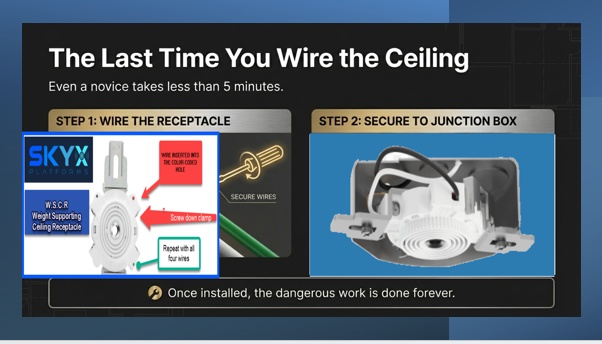
SKYX didn’t just make a nicer junction box. They built a weight‑supporting, plug‑and‑play ceiling outlet—a receptacle in the ceiling that you:
Key pieces:
ESG: comfort with less waste
From an ESG and power‑conservation lens, SkyFan + Turbo Heater is exactly what regulators and investors say they want:
For hotels, REITs, and large building owners:
Smarter, ceiling‑based comfort control can reduce overall energy consumption and support ESG targets without sacrificing guest or tenant comfort.
SkyFan + Turbo Heater isn’t just about feeling cozy. It’s about moving heat off the floor and onto a safer, smarter platform, while cutting wasted energy and hardware clutter.
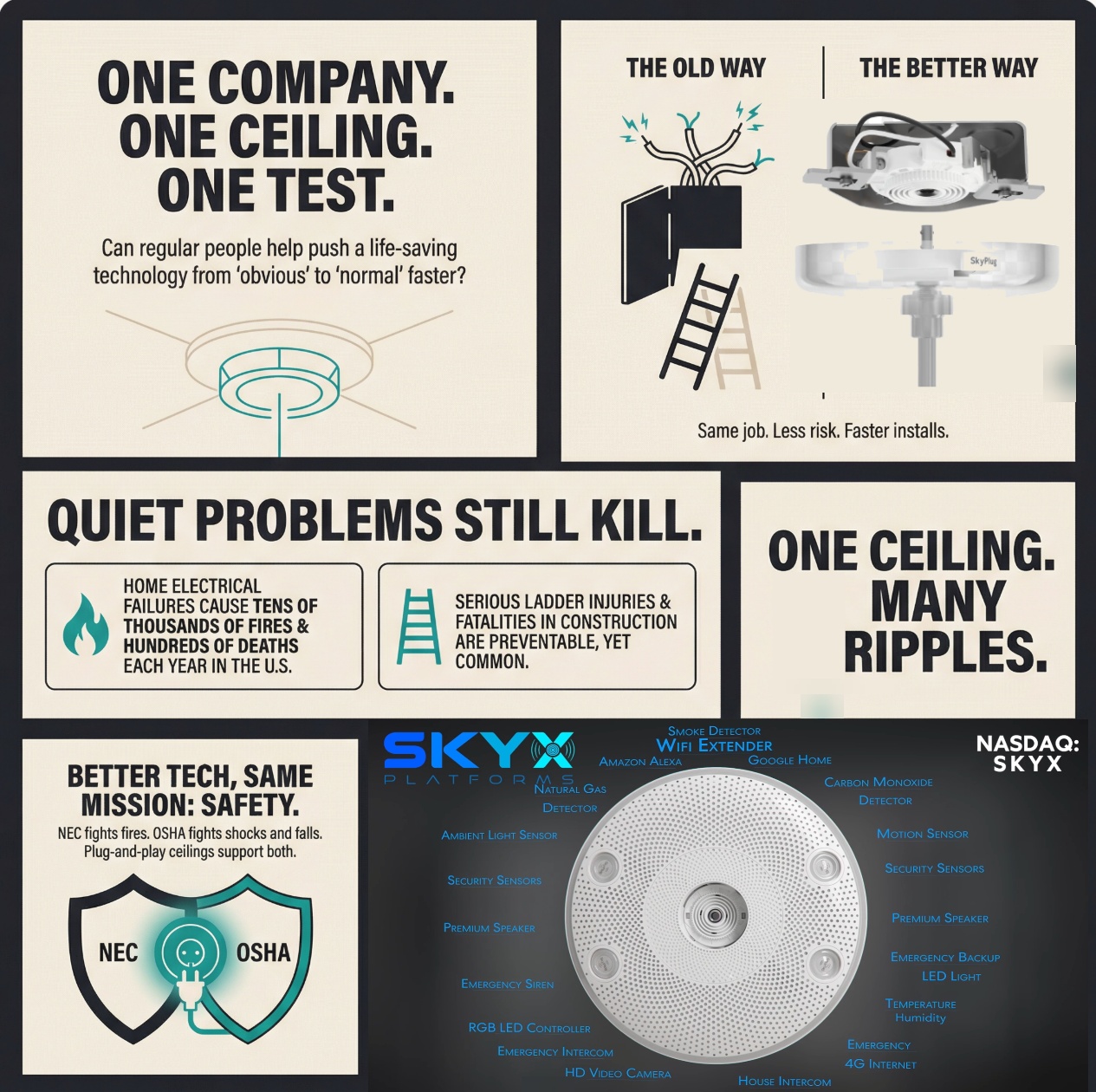
Future‑proof: the ceiling as a smart node
The first generation SKYX outlet solves install safety and speed. The newer and upcoming layers turn it into a smart node that can run apps.
Pieces of that stack:
Once the platform is in:
Retrofitting “smart” becomes a hardware swap, not a rewiring job.
Hotels, REITs, and big owners can standardize behavior across hundreds of properties using the same ceiling port and software stack.
That’s what “future‑proof” actually means: you’re not betting on one fan or light. You’re betting on a ceiling standard that can host whatever comes next.
SKYX1-6 Series · Part 2 of 6
View full seriesSKYX Part 2: The Solution – Turning the Ceiling Into a Safe, Smart Platform
In Part 1, we talked about the problem: ladders, live wires, wire-nuts, and a century‑old installation method that keeps putting people in the hospital. Now let’s talk about the solution: a ceiling system that’s engineered, standardized, and smart enough to make the old way look primitive.
April 24, 2026-Video Interview
In Part 1, we talked about the problem: ladders, live wires, wire-nuts, and a century‑old installation method that keeps putting people in the hospital.
Now let’s talk about the solution: a ceiling system that’s engineered, standardized, and smart enough to make the old way look primitive.
What SKYX actually built
SKYX didn’t just make a nicer junction box. They built a weight‑supporting, plug‑and‑play ceiling outlet—a receptacle in the ceiling that you:
- Wire once, like a permanent infrastructure component.
- Then plug fans, lights, and smart devices into the WSCR with a Skyplug mating connector that takes seconds to install
- Think of it as turning the ceiling into a socket, the way the wall outlet replaced hard‑wired lamps.
Key pieces:
- A ceiling outlet that supports the physical weight of fixtures and fans.
- A locking plug that carries power (and in newer versions, data).
- A design that makes it almost impossible to be up on a ladder with bare live wires in your hands once the outlet is in.
- The dangerous part is front‑loaded into a single, code‑compliant step. Everything after that is plug‑and‑play.
- Safer installs: less ladder time, no exposed wires
With the SKYX platform:
The electrician wires the outlet once, in a controlled manner, using a mechanical design meant to bear weight and hold connections securely. After that, installing or swapping a fixture or fan is basically: climb, plug, turn, lock, climb down.
The electrician wires the outlet once, in a controlled manner, using a mechanical design meant to bear weight and hold connections securely. After that, installing or swapping a fixture or fan is basically: climb, plug, turn, lock, climb down.
That shifts the risk in three big ways:
Ladder exposure drops: time on the ladder for future swaps goes from “wire a whole fixture overhead” to “plug in a connector.”
Live-wire contact drops: there are no loose hot conductors during a normal swap if the system is used as designed.
Mechanical risk drops: the outlet is engineered to support loads, not just whatever a random box-and-bracket setup can handle.
You’re replacing a century of improvisation with a repeatable, engineered process.
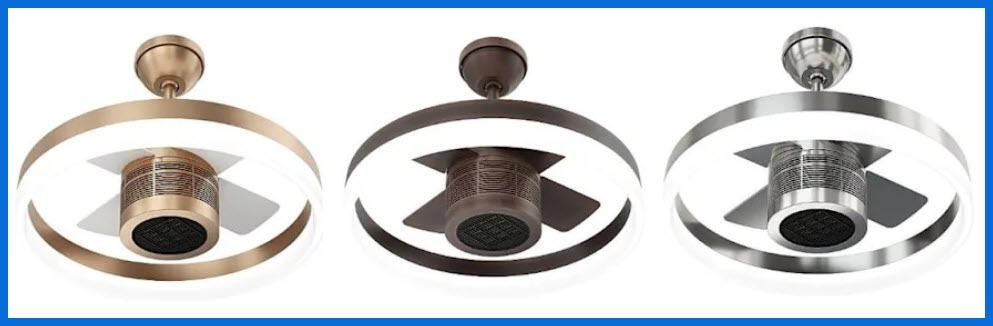 The SkyFan + Turbo Heater: All Seasons 3 & 1 Fan proof the platform works
If you want one product that shows what this platform unlocks, it’s the SkyFan + Turbo Heater.
This isn’t “just another fan”:
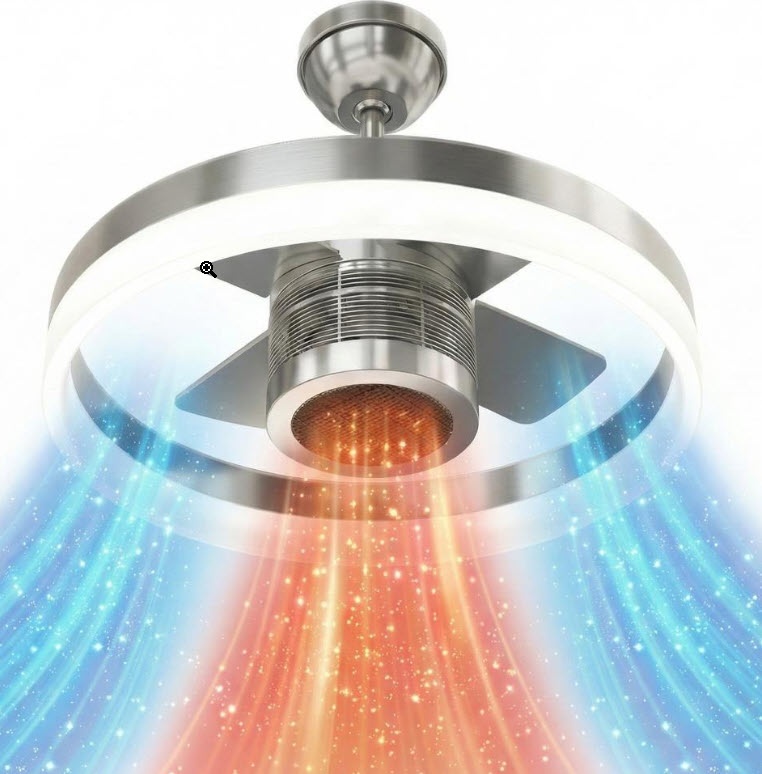
It’s a four‑blade fandelier with integrated LED lighting, designed for the SKYX plug‑and‑play system.
It includes a built‑in turbo heater—around 4,000 BTUs—so the same unit can heat in winter and circulate cool air in summer.
It’s marketed and sold as a plug‑and‑play device that installs in under 60 seconds when you already have the ceiling outlet in place.
Why that matters:
A four‑season fan + heater + light used to mean more wiring, more materials, and more complexity in the ceiling. With the SKYX outlet, it’s just another “payload” you plug into the same standardized socket.
SkyFan isn’t the endgame. It’s the example: once you standardize the ceiling, you can keep shipping new kinds of devices without changing the infrastructure.
SkyFan + Turbo Heater: safer heat, smarter energy
Most people don’t think “ceiling fan” when they think of safety. The All Seasons Fan/ Heater hits two important zones: space heater safety and wasted energy
Ladder exposure drops: time on the ladder for future swaps goes from “wire a whole fixture overhead” to “plug in a connector.”
Live-wire contact drops: there are no loose hot conductors during a normal swap if the system is used as designed.
Mechanical risk drops: the outlet is engineered to support loads, not just whatever a random box-and-bracket setup can handle.
You’re replacing a century of improvisation with a repeatable, engineered process.
If you want one product that shows what this platform unlocks, it’s the SkyFan + Turbo Heater.
This isn’t “just another fan”:
It’s a four‑blade fandelier with integrated LED lighting, designed for the SKYX plug‑and‑play system.
It includes a built‑in turbo heater—around 4,000 BTUs—so the same unit can heat in winter and circulate cool air in summer.
It’s marketed and sold as a plug‑and‑play device that installs in under 60 seconds when you already have the ceiling outlet in place.
Why that matters:
A four‑season fan + heater + light used to mean more wiring, more materials, and more complexity in the ceiling. With the SKYX outlet, it’s just another “payload” you plug into the same standardized socket.
SkyFan isn’t the endgame. It’s the example: once you standardize the ceiling, you can keep shipping new kinds of devices without changing the infrastructure.
SkyFan + Turbo Heater: safer heat, smarter energy
Most people don’t think “ceiling fan” when they think of safety. The All Seasons Fan/ Heater hits two important zones: space heater safety and wasted energy
Safer than the average space heater
SkyFan + Turbo Heater flips that:
Is anything “risk‑free”? No. But a heater locked safely overhead, on a controlled circuit, is a world away from a cheap floor unit roasting next to a laundry pile.
- Traditional portable heaters are a quiet disaster:
- They sit on the floor, near curtains, furniture, pets, and kids.
- They get knocked over, covered, or plugged into sketchy outlets and power strips.
- They’re tied to thousands of fires and injuries every year in real‑world data.
- The heater is up at the ceiling, integrated into a fandelier that’s mechanically supported and fixed in place.
- It’s not sitting on carpet, under a desk, or next to bedding—so the big human‑error fire scenarios (knock‑over, blocked intake, contact with combustibles) are massively reduced.
- Power is delivered through an engineered ceiling outlet, not an overtaxed extension cord or strip.
Is anything “risk‑free”? No. But a heater locked safely overhead, on a controlled circuit, is a world away from a cheap floor unit roasting next to a laundry pile.
I am not telling people about this without having tried it for myself. As soon as the All Seasons Fan hit stores, I ordered one and installed it myself. I love this fan! It is well built and was a breeze to install.
Watch Video Here https://youtu.be/pf9W2J01xx8?si=N9CUAE93rYDh1WCB
ESG: comfort with less waste
From an ESG and power‑conservation lens, SkyFan + Turbo Heater is exactly what regulators and investors say they want:
- Targeted heat: instead of cranking the whole HVAC system or running multiple floor heaters, you add focused warmth right where people are.
- Better air mixing: in winter, the fan pushes warm air down from the ceiling; in summer, it enhances cooling so you can feel comfortable at slightly lower heating or higher cooling setpoints.
- 4‑season utility: one ceiling device does year‑round work—air movement, lighting, and supplemental heat—so you need fewer separate gadgets drawing power and being manufactured in the first place.
For hotels, REITs, and large building owners:
Smarter, ceiling‑based comfort control can reduce overall energy consumption and support ESG targets without sacrificing guest or tenant comfort.
SkyFan + Turbo Heater isn’t just about feeling cozy. It’s about moving heat off the floor and onto a safer, smarter platform, while cutting wasted energy and hardware clutter.
Future‑proof: the ceiling as a smart node
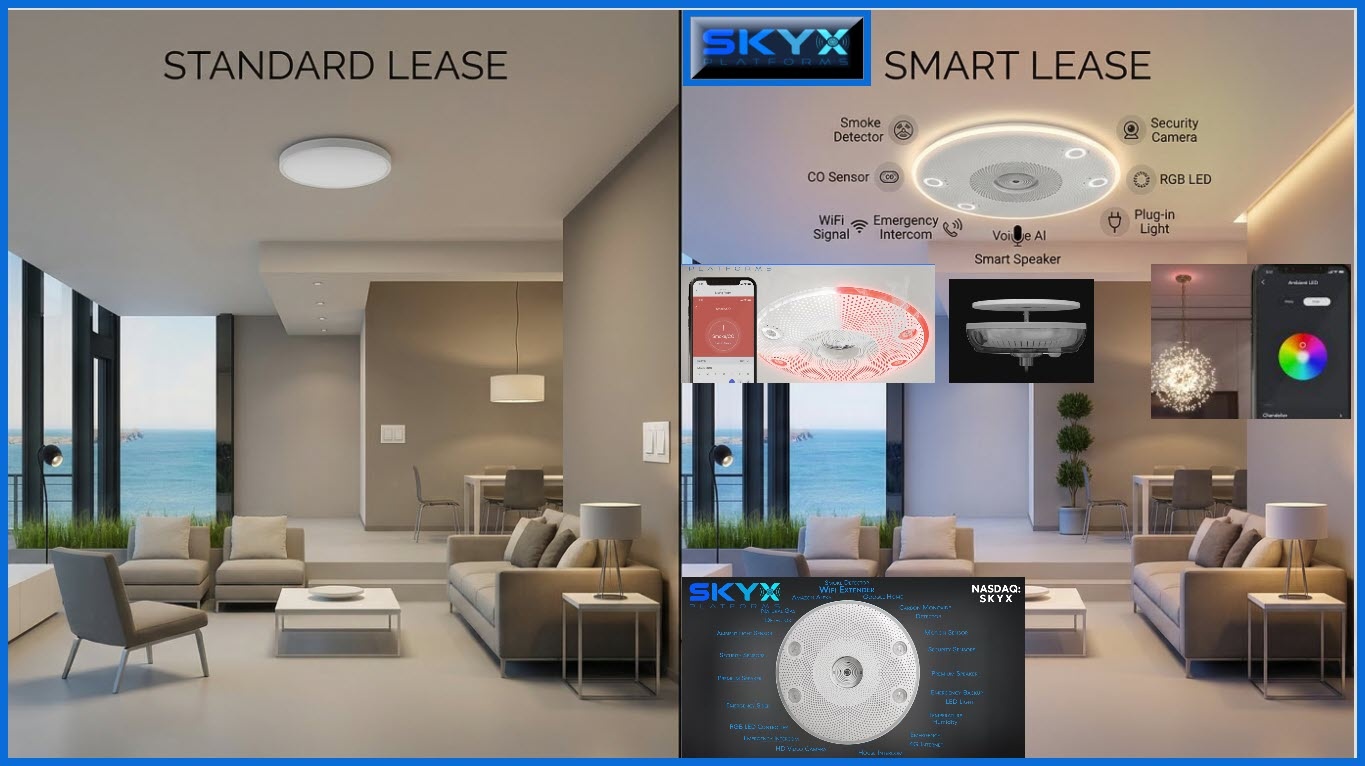
The first generation SKYX outlet solves install safety and speed. The newer and upcoming layers turn it into a smart node that can run apps.
Pieces of that stack:
- Smart plugs and hubs that can control on/off, dimming, color, and scene behavior for fixtures across a home or building.
- Building apps (like SkyHome and other tools) that let owners manage lights, fans, emergency behavior, and occupancy‑based control from a central interface.
- A roadmap that includes sensors (motion, temperature, humidity, possibly air quality) integrated at the ceiling level.
Once the platform is in:
Retrofitting “smart” becomes a hardware swap, not a rewiring job.
Hotels, REITs, and big owners can standardize behavior across hundreds of properties using the same ceiling port and software stack.
That’s what “future‑proof” actually means: you’re not betting on one fan or light. You’re betting on a ceiling standard that can host whatever comes next.
AI and NVIDIA: this is not a dumb metal part
To really drive home that SKYX is a technology platform, not a commodity hardware vendor, look at who they’re working with.
SKYX announced a collaboration with NVIDIA through the NVIDIA Connect Program to build an AI‑powered cloud and edge ecosystem around its patented ceiling platform. The goal is to enable intelligence across voice, audio, safety, environmental monitoring, behavioral patterns, and predictive analytics at the ceiling level.
What that unlocks over time: (My Speculation here)
Hardware companies ship units and hope for reorders. Platform companies turn each install into a data node that can run software, deliver analytics, and support recurring revenue. SKYX is clearly chasing the second path.
Safety beyond the ladder
The first layer of safety is obvious: less time on ladders, fewer live-wire contacts, stronger mechanical support.
But once you bring apps and AI into the picture, safety expands: (Speculation)
The key idea: the job isn’t done when the worker climbs down. A smarter ceiling protects people every day the building is alive.
What Part 2 really means, in plain English
If Part 1 is “we have a serious ceiling problem,” Part 2 is:
We now have a ceiling system that is engineered instead of improvised.
We have proof that products like SkyFan + Turbo Heater demonstrate how flexible the platform is—and how it improves safety and ESG.
We have an AI and app roadmap that can turn each ceiling port into a smart, safety‑enhancing node for homes, hotels, and entire portfolios.
 In other words: SKYX isn’t just trying to sell you a better box. They’re trying to upgrade the ceiling from a hazard to a platform.
SKYX Blog Disclaimer & Disclosures
All content in this SKYX series is for informational and educational purposes only. It is based on my personal opinions and experience and should not be taken as financial, legal, tax, or investment advice. Nothing in these posts is a recommendation or solicitation to buy, sell, or hold any security, including SKYX Platforms Corp.
I may have provided, or may in the future provide, consulting or other services to SKYX Platforms Corp. Any such relationship does not control or pre-approve what I write here. The views and analyses in this blog are my own and are based on information I believe to be reliable at the time of writing, but I do not guarantee accuracy or completeness.
I currently own shares of SKYX Platforms Corp., and I may buy more, trim, or fully exit my position at any time, without notice. My personal trading may be different from anything discussed in these posts.
Investing in stocks involves risk, including the possible loss of some or all of your money. You are responsible for your own investment decisions. Always do your own research and, if needed, talk with a qualified financial professional who understands your personal situation, goals, and risk tolerance before acting on anything you read here.
By reading this blog, you agree that you use this information at your own risk and that I am not liable for any losses or damages that may result from your investment decisions.
To really drive home that SKYX is a technology platform, not a commodity hardware vendor, look at who they’re working with.
SKYX announced a collaboration with NVIDIA through the NVIDIA Connect Program to build an AI‑powered cloud and edge ecosystem around its patented ceiling platform. The goal is to enable intelligence across voice, audio, safety, environmental monitoring, behavioral patterns, and predictive analytics at the ceiling level.
What that unlocks over time: (My Speculation here)
- Voice‑enabled control and automation, via integrations with voice/AI stacks that can ride on top of the platform.
- Real‑time anomaly detection—devices that can “know” if something is overheating, vibrating wrong, or behaving outside normal patterns.
- Predictive maintenance and safety alerts for building operators, hotels, and REITs across hundreds of thousands of installed nodes.
Hardware companies ship units and hope for reorders. Platform companies turn each install into a data node that can run software, deliver analytics, and support recurring revenue. SKYX is clearly chasing the second path.
Safety beyond the ladder
The first layer of safety is obvious: less time on ladders, fewer live-wire contacts, stronger mechanical support.
But once you bring apps and AI into the picture, safety expands: (Speculation)
- Emergency behavior: fixtures that automatically go to a pre‑set brightness or pattern during outages, alarms, or power issues.
- Occupancy and path‑of‑egress lighting in hotels and large buildings driven from the ceiling, not hacked together floor by floor.
- Environmental monitoring at scale—temperature spikes, unusual motion, or other anomalies that might signal a problem before it becomes a disaster.
The key idea: the job isn’t done when the worker climbs down. A smarter ceiling protects people every day the building is alive.
What Part 2 really means, in plain English
If Part 1 is “we have a serious ceiling problem,” Part 2 is:
We now have a ceiling system that is engineered instead of improvised.
We have proof that products like SkyFan + Turbo Heater demonstrate how flexible the platform is—and how it improves safety and ESG.
We have an AI and app roadmap that can turn each ceiling port into a smart, safety‑enhancing node for homes, hotels, and entire portfolios.
SKYX Blog Disclaimer & Disclosures
All content in this SKYX series is for informational and educational purposes only. It is based on my personal opinions and experience and should not be taken as financial, legal, tax, or investment advice. Nothing in these posts is a recommendation or solicitation to buy, sell, or hold any security, including SKYX Platforms Corp.
I may have provided, or may in the future provide, consulting or other services to SKYX Platforms Corp. Any such relationship does not control or pre-approve what I write here. The views and analyses in this blog are my own and are based on information I believe to be reliable at the time of writing, but I do not guarantee accuracy or completeness.
I currently own shares of SKYX Platforms Corp., and I may buy more, trim, or fully exit my position at any time, without notice. My personal trading may be different from anything discussed in these posts.
Investing in stocks involves risk, including the possible loss of some or all of your money. You are responsible for your own investment decisions. Always do your own research and, if needed, talk with a qualified financial professional who understands your personal situation, goals, and risk tolerance before acting on anything you read here.
By reading this blog, you agree that you use this information at your own risk and that I am not liable for any losses or damages that may result from your investment decisions.
← Previous in SKYX1-6 Series SeriesPart 1: SKYX Article 1 – Old Ceilings, Real Bodies: Why A 1920s Ceiling System Still Hurts People In 2026Next in SKYX1-6 Series Series →Part 3: SKYX Part 3: The Grind – A Decade of Codes, Standards, and Why the Language Still Sounds So Tame
Join The Wave
Get Early Access & Exclusive Intel
The Watchlist. Full deep-dives. Monthly Wave Room. Early video access. Everything serious impact investors need — before the crowd catches on.
Free. Unsubscribe anytime. By subscribing you agree to our Privacy Policy.