Back to Blog
SKYX1-6 Series · Part 1 of 6
View full seriesSKYX Article 1 – Old Ceilings, Real Bodies: Why A 1920s Ceiling System Still Hurts People In 2026
When you zoom out and look at the numbers, it’s insane how much damage this 100‑year‑old way of doing ceilings still causes.
April 23, 2026
The Ceiling Nobody Thinks About
Picture this.
A hotel maintenance tech rolls a ladder into a guest room.
The room is quiet. The bed is made. Tomorrow’s check‑in is fully booked.
He tilts the ladder under the old ceiling fan, climbs up, and suddenly he’s in that familiar position: feet on aluminum, head inches from drywall, both hands busy. One hand is holding the fan. The other is fighting wire nuts and bare wires in a cramped metal box above his head.
He’s rushing.
He’s tired.
And one tiny mistake—one missed step, one bad connection—can ripple way beyond that one room.
We’ve normalized this scene.
We act like it’s just part of the job.
But when you zoom out and look at the numbers, it’s insane how much damage this 100‑year‑old way of doing ceilings still causes.
Ladders: The Most Dangerous Tool In the Room
Any time someone changes a ceiling fan or light the old way, a ladder appears.
Let’s get real about what ladders actually do to people.
The Bureau of Labor Statistics reports that in 2020, ladders were the primary source in 161 fatal work injuries in the United States. In that same year, there were 22,710 nonfatal ladder injuries serious enough that workers missed at least one day of work.
That’s just the workplace side.
When you widen the lens to all ladder users—DIYers, homeowners, retirees—the picture gets even uglier. Safety organizations estimate hundreds of deaths and well over 100,000 emergency room visits every year in the U.S. from ladder falls alone. One analysis put it at roughly 136,000 ER visits per year, or about 49.5 ladder‑fall injuries per 100,000 people annually.
Now ask yourself: how many of those scenarios look like this?
It doesn’t take much.
A slip. A wobble. One bad step down.
Gravity does the rest.
And every time we say, “that’s just construction,” we’re really saying “we’re fine with a system that injures thousands of people a year so we can keep doing ceilings the way we did them in 1926.”
Wire Nuts: A 1920s Fix In A 2020s World
Step back 100 years.
Before wire nuts, if you wanted to join wires, you twisted bare copper together by hand, soldered the joint, and wrapped it in cloth tape. It was slow, fiddly, and took real skill.
Twist‑on wire connectors—what we call wire nuts—showed up as a game‑changer in the early 20th century. They made connections faster and more repeatable. Electricians could twist wires together, spin on a cap, and move on. Over time, wire nuts became the default in North America for joining conductors in junction boxes.
In the 1920s, their solution was a huge step forward.
But here’s the problem: in a lot of ceilings, the process still looks almost exactly the same as it did back then.
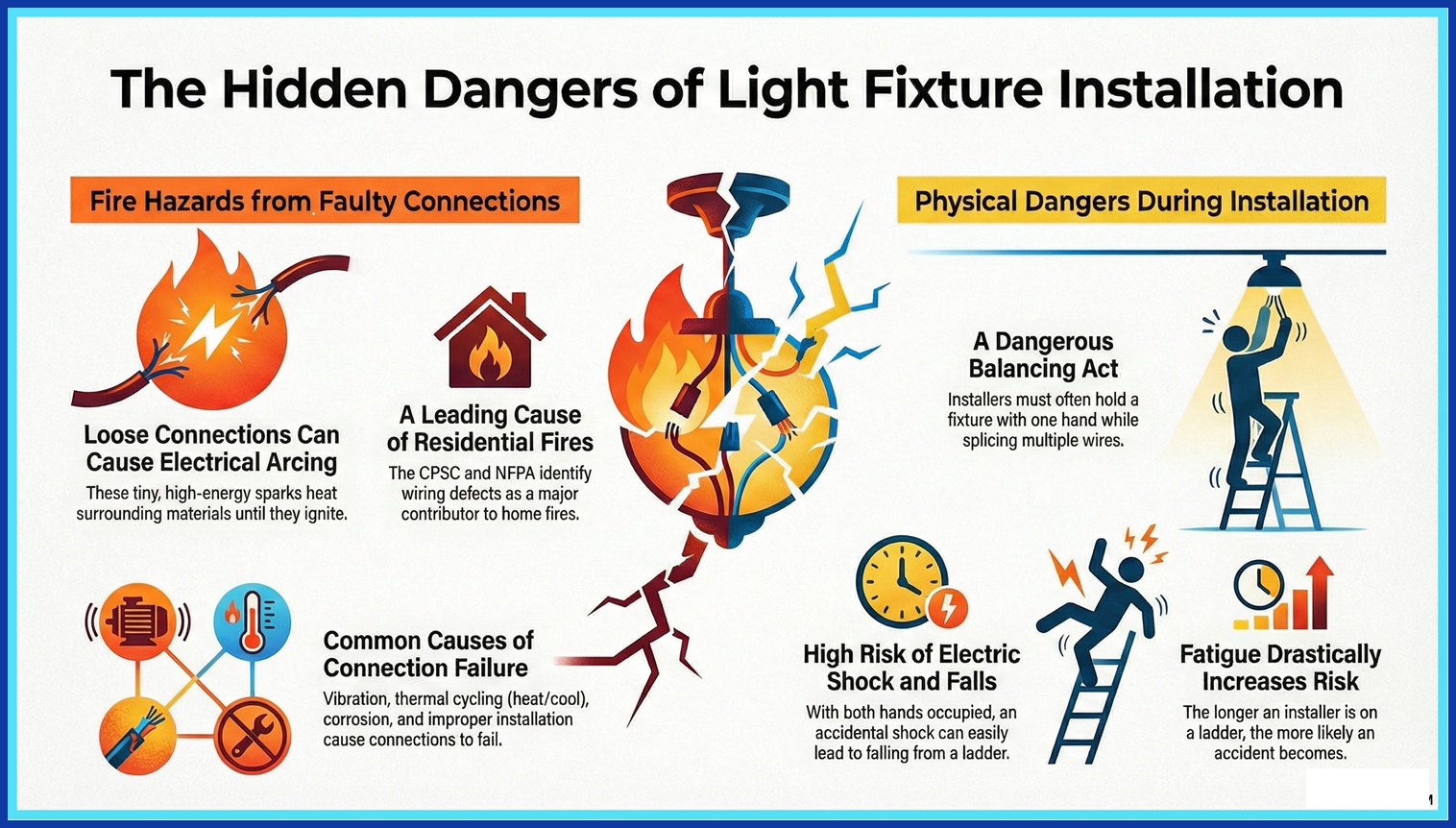
This is delicate work performed:
Often at night, or under time pressure.
Even when the wiring is done perfectly, it’s still hard physical overhead work at height. When it’s not done perfectly—that’s when the risks stack up.
All of that is happening in a box you rarely open, above rooms where families sleep, kids play, or guests stay.
Wire nuts were a breakthrough in the 20th century.
But treating them as “good enough forever” in every ceiling is like saying flip phones are fine because they were better than rotary.
The Electrical Safety Foundation International (ESFI) estimates that in the United States, home electrical fires account for around 51,000 fires each year. Those fires cause:
Nearly 500 deaths
More than 1,400 injuries
About $1.3 billion in property damage annually
Electrical distribution systems—wiring, breakers, panels, and junction boxes—are the third-leading cause of home structure fires.
The U.S. Consumer Product Safety Commission (CPSC) reports that electrical receptacles alone are involved in about 5,300 fires every year, causing 40 deaths and more than 100 consumer injuries.
Old methods
Hidden connections.
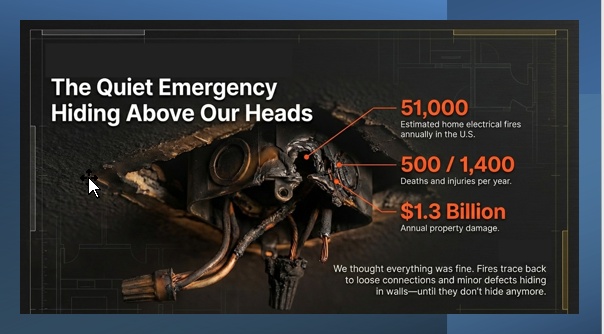
Ceiling boxes sit right in that web.
They’re one of the places where rushed work, loose wire nuts, and aging hardware can hide in plain sight, directly over people’s heads.
Now layer that on top of the old electrical infrastructure.
Recent NFPA data shows that, on average, home heating equipment (furnaces, fireplaces, space heaters, etc.) is involved in tens of thousands of fires every year in the U.S., causing hundreds of deaths and over a thousand injuries annually. Space heaters and similar devices account for a relatively small share of incidents—but a massive share of deaths and injuries.
The CPSC has warned for years that space heaters are associated with approximately 21,800 residential fires annually, leading to about 300 deaths and countless injuries. Many of these fires involve:
What does this have to do with ceilings?
Everything. Because when we accept outdated electrical infrastructure everywhere—walls, outlets, ceiling boxes—we create a system that’s fragile from top to bottom. The same mindset that says:
“Twisting wires together on a ladder is fine; we’ve always done it that way.
“Plugging a high‑draw heater into an overloaded outlet is fine; we’ve always done it that way.”
In both cases, we’re gambling with lives on habits born in a different era.
But when you zoom out, the ripple looks like this:
We’ve built an entire culture on top of the assumption that this is just the cost of doing business.
161 workers killed by ladders in one year. Over 22,700 serious ladder injuries in the workplace alone—thousands of those in installation and maintenance jobs.
Around 51,000 home electrical fires a year, killing hundreds, injuring more than a thousand, and causing over a billion dollars in damage.
Tens of thousands of heating and space‑heater‑related fires, with a disproportionate share of deaths.
No single ceiling change “causes” all that.
But the old ceiling system is part of the same pattern: a 1920s mindset powering 2026 lives.
A System Stuck In 1926
Think about how much has changed since the 1920s:
Now think about what still happens at the ceiling in most North American buildings when you hang a fan or light:
It’s not that wire nuts and ladders were evil. They were the best tools we had at the time. It’s that we’ve stopped asking the question:
“Is this still the best we can do, or have we just gotten comfortable with the risk?”
In 2020, ladders were the primary source of 161 fatal U.S. work injuries and 22,710 nonfatal work injuries that caused at least one day away from work. Thousands of these injuries hit installation, maintenance, and repair workers.
Home electrical fires cause about 51,000 fires, nearly 500 deaths, more than 1,400 injuries, and $1.3 billion in property damage every year in the U.S.
Electrical distribution systems are the third leading cause of home structure fires.
Electrical receptacles are involved in about 5,300 fires, 40 deaths, and 100+ injuries annually.
Home heating equipment, including space heaters, is associated with tens of thousands of fires and hundreds of deaths each year; space heaters account for a small share of incidents but a large share of deaths.
Twist‑on wire connectors (wire nuts) date back to the early 20th century and became common in the 1920s as a faster alternative to soldered splices.
My speculation/opinion
In my view, the ceiling is one of the most dangerous square feet in the entire building, not because it’s evil, but because it’s frozen in time. We built an entire system on ladders, wire nuts, and “good enough” wiring habits that made sense 100 years ago and never really upgraded the core idea.
I believe a lot of today’s injuries and fires are the compound interest on that decision.
Every time someone climbs a ladder with both hands occupied to fight with wires over their head, we’re rolling the dice again. Every time an old connection in a ceiling box gets hotter than it should, we’re asking a 1920s solution to save a 2026 family.
The question is not if the ceiling needs to change.
The question is what replaces it.
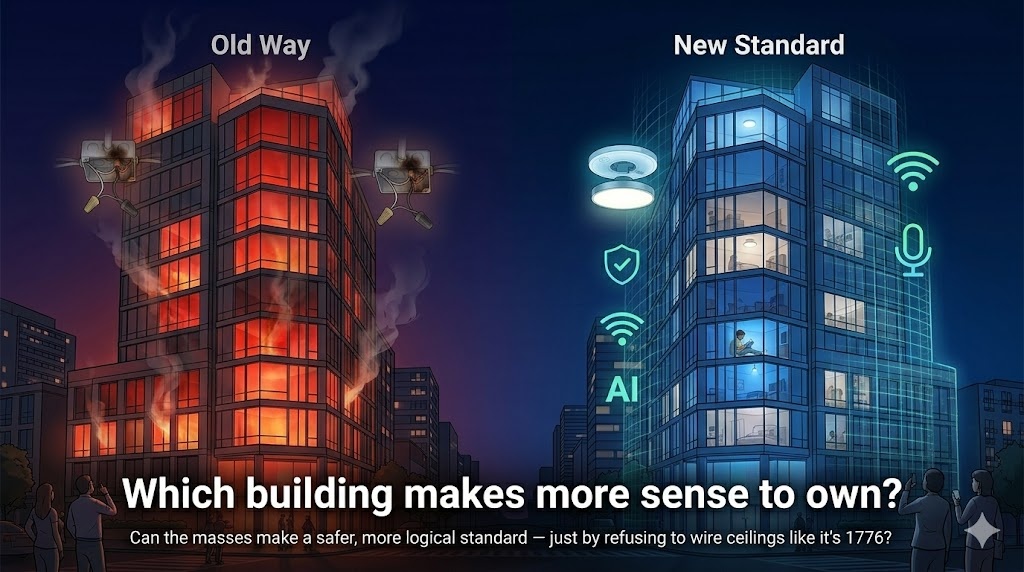
That’s where the next part of this series comes in.
Picture this.
A hotel maintenance tech rolls a ladder into a guest room.
The room is quiet. The bed is made. Tomorrow’s check‑in is fully booked.
He tilts the ladder under the old ceiling fan, climbs up, and suddenly he’s in that familiar position: feet on aluminum, head inches from drywall, both hands busy. One hand is holding the fan. The other is fighting wire nuts and bare wires in a cramped metal box above his head.
He’s rushing.
He’s tired.
And one tiny mistake—one missed step, one bad connection—can ripple way beyond that one room.
We’ve normalized this scene.
We act like it’s just part of the job.
But when you zoom out and look at the numbers, it’s insane how much damage this 100‑year‑old way of doing ceilings still causes.
Ladders: The Most Dangerous Tool In the Room
Any time someone changes a ceiling fan or light the old way, a ladder appears.
Let’s get real about what ladders actually do to people.
The Bureau of Labor Statistics reports that in 2020, ladders were the primary source in 161 fatal work injuries in the United States. In that same year, there were 22,710 nonfatal ladder injuries serious enough that workers missed at least one day of work.
Look closer at who gets hurt:
- Installation, maintenance, and repair workers—the exact people who fix lights and fans—suffered 5,790 ladder injuries that year.
- Construction and extraction workers had 5,370 ladder injuries.
- Service workers (think hotel, building, and facility staff) had 3,160.
That’s just the workplace side.
When you widen the lens to all ladder users—DIYers, homeowners, retirees—the picture gets even uglier. Safety organizations estimate hundreds of deaths and well over 100,000 emergency room visits every year in the U.S. from ladder falls alone. One analysis put it at roughly 136,000 ER visits per year, or about 49.5 ladder‑fall injuries per 100,000 people annually.
Now ask yourself: how many of those scenarios look like this?
- A worker on a ladder, both hands occupied, reaching up into a ceiling box.
- A homeowner leaning a little too far to the side, trying to twist wire nuts.
- A tech swapping fixtures over a bed or a bathtub, alone, because “it’s just a quick job.”
It doesn’t take much.
A slip. A wobble. One bad step down.
Gravity does the rest.
And every time we say, “that’s just construction,” we’re really saying “we’re fine with a system that injures thousands of people a year so we can keep doing ceilings the way we did them in 1926.”
Wire Nuts: A 1920s Fix In A 2020s World
Step back 100 years.
Before wire nuts, if you wanted to join wires, you twisted bare copper together by hand, soldered the joint, and wrapped it in cloth tape. It was slow, fiddly, and took real skill.
Twist‑on wire connectors—what we call wire nuts—showed up as a game‑changer in the early 20th century. They made connections faster and more repeatable. Electricians could twist wires together, spin on a cap, and move on. Over time, wire nuts became the default in North America for joining conductors in junction boxes.
We owe those inventors credit.
In the 1920s, their solution was a huge step forward.But here’s the problem: in a lot of ceilings, the process still looks almost exactly the same as it did back then.
- The scene:
- You kill the breaker (hopefully).
- You climb the ladder.
- You fish the wires out of the metal box.
- You strip the insulation back.
- You twist conductors together by hand, overhead, in a cramped space.
- You spin on a wire nut, tug, and hope it holds.
- Then you try to mount a fixture or fan while everything is still up there.
This is delicate work performed:
- Above your head.
- While you’re balancing.
- With your hands full.
Often at night, or under time pressure.
Even when the wiring is done perfectly, it’s still hard physical overhead work at height. When it’s not done perfectly—that’s when the risks stack up.
- Loose connections.
- Overheated splices.
- Strain on the joint from the weight of the fixture.
- Years of vibration from ceiling fans.
All of that is happening in a box you rarely open, above rooms where families sleep, kids play, or guests stay.
Wire nuts were a breakthrough in the 20th century.
But treating them as “good enough forever” in every ceiling is like saying flip phones are fine because they were better than rotary.
Electrical Fires: When Old Wiring Bites Back
Let’s move from falls to fires.The Electrical Safety Foundation International (ESFI) estimates that in the United States, home electrical fires account for around 51,000 fires each year. Those fires cause:
Nearly 500 deaths
More than 1,400 injuries
About $1.3 billion in property damage annually
Electrical distribution systems—wiring, breakers, panels, and junction boxes—are the third-leading cause of home structure fires.
On top of that:
The U.S. Consumer Product Safety Commission (CPSC) reports that electrical receptacles alone are involved in about 5,300 fires every year, causing 40 deaths and more than 100 consumer injuries.
Here’s what that really means in human terms:
- Families waking up to smoke because something inside the walls or ceiling finally failed.
- Owners who thought their wiring was “fine” because the lights still turned on.
- Buildings with layers of old work, patched‑over repairs, and hidden junction boxes nobody has opened in decades.
- You and I don’t need to claim that “most” of those fires start at ceiling fixtures to see the pattern. The pattern is:
Old methods
Hidden connections.
Too much faith in “it’s always been done this way.”
Ceiling boxes sit right in that web.
They’re one of the places where rushed work, loose wire nuts, and aging hardware can hide in plain sight, directly over people’s heads.
Space Heaters: The Second Front In the Same Wave.
Think about what space heaters really are: a band‑aid. They show up when the main heating system is weak, broken, or when people need extra warmth in rooms that weren’t designed for it.Now layer that on top of the old electrical infrastructure.
Recent NFPA data shows that, on average, home heating equipment (furnaces, fireplaces, space heaters, etc.) is involved in tens of thousands of fires every year in the U.S., causing hundreds of deaths and over a thousand injuries annually. Space heaters and similar devices account for a relatively small share of incidents—but a massive share of deaths and injuries.
The CPSC has warned for years that space heaters are associated with approximately 21,800 residential fires annually, leading to about 300 deaths and countless injuries. Many of these fires involve:
- Heaters placed too close to bedding, curtains, or furniture
- Overloaded outlets and extension cords
- Older wiring and circuits not designed for constant high loads
What does this have to do with ceilings?
Everything. Because when we accept outdated electrical infrastructure everywhere—walls, outlets, ceiling boxes—we create a system that’s fragile from top to bottom. The same mindset that says:
“Twisting wires together on a ladder is fine; we’ve always done it that way.
“Plugging a high‑draw heater into an overloaded outlet is fine; we’ve always done it that way.”
In both cases, we’re gambling with lives on habits born in a different era.
The Negative Ripple: One Box, Many Victims
It’s easy to look at a single junction box and shrug.- It’s small.
- It’s hidden.
- It’s “just a fan” or “just a light.”
But when you zoom out, the ripple looks like this:
- Worker falls from a ladder:
- Hospital visit. Rehab. Time off work.
- A family suddenly living on a reduced income.
- A contractor is short‑staffed and under pressure, which can lead to even more rushed jobs.
- Home electrical fire from wiring or overloaded circuits:
- Family displaced. Pets lost. Photos and memories gone.
- Kids are waking up with nightmares every time they smell smoke.
- Landlords, builders, and inspectors are dragged into lawsuits.
- Hotel or apartment incident tied to the ceiling or electrical faults:
- Guests injured or traumatized.
- Brand damage that echoes online for years.
- Legal and insurance costs that don’t show up on any “materials budget” spreadsheet.
We’ve built an entire culture on top of the assumption that this is just the cost of doing business.
But look at the numbers again:
161 workers killed by ladders in one year. Over 22,700 serious ladder injuries in the workplace alone—thousands of those in installation and maintenance jobs.
Around 51,000 home electrical fires a year, killing hundreds, injuring more than a thousand, and causing over a billion dollars in damage.
Tens of thousands of heating and space‑heater‑related fires, with a disproportionate share of deaths.
No single ceiling change “causes” all that.
But the old ceiling system is part of the same pattern: a 1920s mindset powering 2026 lives.
A System Stuck In 1926
Think about how much has changed since the 1920s:
- Cars now park themselves.
- Phones replaced landlines, cameras, and maps.
- We control entire homes from an app.
Now think about what still happens at the ceiling in most North American buildings when you hang a fan or light:
- Climb a ladder.
- Pull bare wires from a box.
- Twist conductors together by hand.
- Cap them with a device invented around the same era as Prohibition.
- Hang weight from that box and hope everything holds up over time.
That’s the part that should bother us.
It’s not that wire nuts and ladders were evil. They were the best tools we had at the time. It’s that we’ve stopped asking the question:
“Is this still the best we can do, or have we just gotten comfortable with the risk?”
- We wouldn’t accept 1920s brakes in a modern car.
- We wouldn’t accept 1920s medical tools in a modern hospital.
- But we still accept 1920s methods in one spot in the room where gravity and electricity meet overhead.
Facts vs. My Interpretation
Facts (from independent sources):In 2020, ladders were the primary source of 161 fatal U.S. work injuries and 22,710 nonfatal work injuries that caused at least one day away from work. Thousands of these injuries hit installation, maintenance, and repair workers.
Home electrical fires cause about 51,000 fires, nearly 500 deaths, more than 1,400 injuries, and $1.3 billion in property damage every year in the U.S.
Electrical distribution systems are the third leading cause of home structure fires.
Electrical receptacles are involved in about 5,300 fires, 40 deaths, and 100+ injuries annually.
Home heating equipment, including space heaters, is associated with tens of thousands of fires and hundreds of deaths each year; space heaters account for a small share of incidents but a large share of deaths.
Twist‑on wire connectors (wire nuts) date back to the early 20th century and became common in the 1920s as a faster alternative to soldered splices.
My speculation/opinion
In my view, the ceiling is one of the most dangerous square feet in the entire building, not because it’s evil, but because it’s frozen in time. We built an entire system on ladders, wire nuts, and “good enough” wiring habits that made sense 100 years ago and never really upgraded the core idea.
I believe a lot of today’s injuries and fires are the compound interest on that decision.
Every time someone climbs a ladder with both hands occupied to fight with wires over their head, we’re rolling the dice again. Every time an old connection in a ceiling box gets hotter than it should, we’re asking a 1920s solution to save a 2026 family.
We can do better than that.
The question is not if the ceiling needs to change.
The question is what replaces it.
That’s where the next part of this series comes in.
Disclaimer:
This article is for informational and educational purposes only and reflects the author’s personal opinions. It is not investment, legal, or construction advice, nor a recommendation to buy or sell any security or product. Always consult qualified professionals before making financial, legal, construction, or safety decisions.
This article is for informational and educational purposes only and reflects the author’s personal opinions. It is not investment, legal, or construction advice, nor a recommendation to buy or sell any security or product. Always consult qualified professionals before making financial, legal, construction, or safety decisions.
Join The Wave
Get Early Access & Exclusive Intel
The Watchlist. Full deep-dives. Monthly Wave Room. Early video access. Everything serious impact investors need — before the crowd catches on.
Free. Unsubscribe anytime. By subscribing you agree to our Privacy Policy.