Back to Blog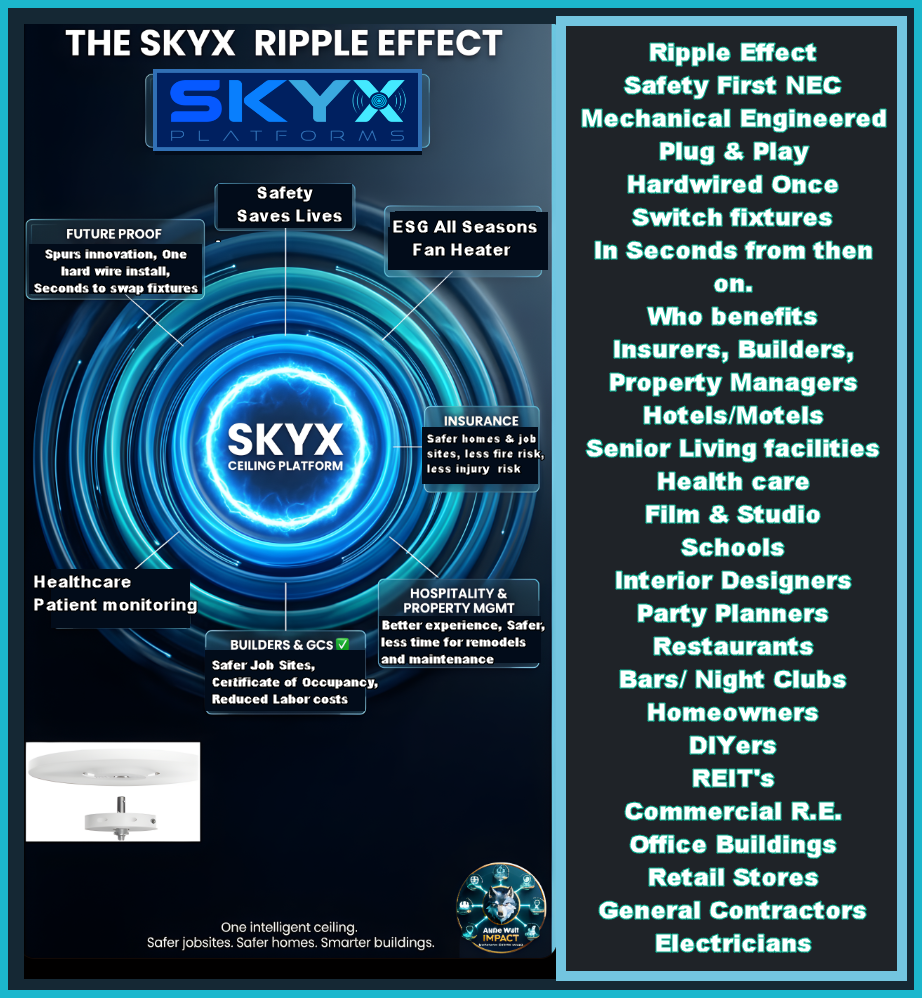
By Tim Weintraut | Alpha Wolf Impact | alphawolfimpact.com
Over the last five articles, we’ve walked through the problem, the product, the proof, the global rollout, and the platform vision. We talked about how the old ceiling method is broken.
How SKYX’s plug‑and‑play outlet fixes real safety and labor problems. How it’s already getting picked up by serious developers on three continents. How the ceiling becomes a “Building App Store” once the platform is standard.
This last piece is about people and persistence.
Who spent 16 years grinding on this?
How have they executed when it wasn’t fun or fashionable?
And why do I think Wall Street still has this story backward?
Sixteen years of grind is not a fad. Rani Kohen, the founder and inventor, has been methodically building this platform, establishing the patent portfolio and assembling a world-class team to help him achieve his vision. If you only glance at a chart, it’s easy to tell yourself a lazy story: “Just another small‑cap gadget.”
But history says something else.
This company has been at it for about 16 years. That’s 16 years of:
You can agree or disagree with where they are today. But you can’t say they haven’t done the work.
The question at this point should not be " Why would anyone use this system?"
SKYX1-6 Series · Part 6 of 6
View full seriesSKYX Article 6: The People, The Grind, and The Mispricing
Why I Think the Market Has SKYX Backward. Wall Street is still pricing SKYX like a quirky hardware company, while the real story looks a lot more like the early days of a new electrical standard.
April 26, 2026
By Tim Weintraut | Alpha Wolf Impact | alphawolfimpact.com
Over the last five articles, we’ve walked through the problem, the product, the proof, the global rollout, and the platform vision. We talked about how the old ceiling method is broken.
How SKYX’s plug‑and‑play outlet fixes real safety and labor problems. How it’s already getting picked up by serious developers on three continents. How the ceiling becomes a “Building App Store” once the platform is standard.
This last piece is about people and persistence.
Who spent 16 years grinding on this?
How have they executed when it wasn’t fun or fashionable?
And why do I think Wall Street still has this story backward?
Sixteen years of grind is not a fad. Rani Kohen, the founder and inventor, has been methodically building this platform, establishing the patent portfolio and assembling a world-class team to help him achieve his vision. If you only glance at a chart, it’s easy to tell yourself a lazy story: “Just another small‑cap gadget.”
But history says something else.
This company has been at it for about 16 years. That’s 16 years of:
- Designing and patenting a mechanically engineered, weight‑supporting ceiling platform.
- Grinding it through the National Electrical Code, ANSI, NEMA, UL, NFPA, and an AIA‑approved course.
- Walking it into CPSC, showing regulators installation videos, and arguing – using their own injury data – that it cuts ladder time, simplifies installs, and makes ceilings safer.
- Running real‑world demonstrations, like the Marriott SpringHill Suites renovation, where the system proved it can refit a hotel room faster and with less risk.
- Turning pilots into multi‑project relationships with developers in Miami, Texas, the Carolinas, Florida, Europe, the Middle East, and prefab factories.
- That is not how a “Johnny‑come‑lately” idea behaves. That’s how a team behaves when it is trying to legitimize a new safety standard.
You can agree or disagree with where they are today. But you can’t say they haven’t done the work.
The question at this point should not be " Why would anyone use this system?"
The question should be WHY WOULDN"T YOU USE THIS SYSTEM?
Eight straight quarters and $92 million
Let’s talk numbers, because execution eventually has to show up in the income statement.
From company reports and coverage:
These are not fantasy projections. These are realized numbers.
Could they be bigger? Sure. Could margins be higher? Of course. But the pattern is what matters to me: while the narrative was “they’ll never execute,” they quietly stacked eight green quarters and pushed revenue into the 90‑plus million range.
That is not what failure looks like.
The capital story everyone freaked out about
Now, the part everyone on social media loves to yell about: cash and dilution.
At the end of 2025, you saw something like:
What actually happened:
They raised roughly $4 million at $2.00. No Warrants
In January 2026, SKYX raised $25 million from a single family office / institutional investor at $2.50 per share, no warrants attached. Clean common stock. The $200 million shelf was renewed because shelves expire on a schedule. If you want flexibility to raise later, you have to keep it active. It does not require them to issue anything. It just gives them the option.
Look at behavior, not fear:
They chose to take what is, in the small‑cap world, fairly surgical capital: a clean raise at reasonable prices, front‑loading the cash they need to keep building.
You cannot build a global ceiling platform, ship hundreds of thousands of units through Home Depot, Walmart, JIT, and others, and invest in new AI features… on fumes. At some point, you have to fund the ramp.
The question isn’t “did they raise?”
So far, the pattern looks cautious, not reckless.
The talent stack: people who don’t need another job
Now to the part many overlook: who decided to put their name on this.
This isn’t a group of first‑time founders hoping for a quick flip. It’s a roster of people who have already had big careers and don’t need to roll the dice unless they believe something is real.
Bob Nardelli – former Chairman and CEO of Home Depot, former Chairman and CEO of Chrysler, and former CEO of GE Power Systems. He understands big‑box retail, heavy infrastructure, and how real categories get built in the aisle.
Al Weiss – a 39‑year Disney veteran, former President of Worldwide Operations for Walt Disney Parks and Resorts, responsible for global parks, resorts, and cruise operations, and roughly 95,000 cast members. He knows how to run complex, safety‑critical operations while delivering themed experiences people never forget.
Steve Schmidt – now President of SKYX, previously CEO at Nielsen and President of Office Depot International. He’s run large global businesses, worked with major retailers, and understands category management and analytics.
Mark Earley – former Chief Engineer and head of the National Electrical Code (NEC). He literally used to oversee the document that tells electricians and inspectors what is acceptable inside ceilings.
Eric Jacobson – former President and CEO of the American Lighting Association (ALA), nearly 30 years in the residential lighting, ceiling fan, and controls world, now SKYX’s Senior Product Standardization Advisor, helping drive the plug‑and‑play outlet toward standard status.
Khadija Mustafa – former Global AI leader at Microsoft, most recently Head of Global AI Sales, Customers & Partner Ecosystem in Microsoft’s Industrial Metaverse, Cloud and AI division, now SKYX’s Senior Tech, AI and Global Business Advisor.
These people aren’t chasing their first break. They have careers, reputations, and options.
Just because you want Nardelli, Weiss, Earley, Jacobson, Schmidt, and Mustafa on your team doesn’t mean they’ll show up. They have to see the product, understand the economics, and believe the platform can become real infrastructure before they attach their names.
They did.
The Disney angle: themed lighting as the easy win
One of the easiest ways to understand the upside here is through themed lighting.
Disney’s genius has always been to make massive, complicated, safety‑critical systems invisible, then use them to deliver pure experience. Power systems. Fire and life‑safety. Ride controls. Crowd management. All hidden under a skin of theming.

Holiday shows, sports nights, corporate event modes, hospitality themes, brand activations — all without rewiring, bucket trucks, or room‑by‑room electrical work. It’s a “no brainer” layer sitting on top of the safety and time‑savings story that Article 1–5 already covered.
If someone who spent nearly four decades making that kind of magic at Disney sees this ceiling platform and says, “I want in,” that’s worth paying attention to.
Eight straight quarters and $92 million
Let’s talk numbers, because execution eventually has to show up in the income statement.
From company reports and coverage:
- 2025 revenue came in around $92 million, up from about $86 million in 2024.
- Q4 2025 revenue was about $25 million, another record quarter.
- That capped eight consecutive quarters of revenue growth.
- Gross profit grew into the tens of millions, with gross margins hovering around the 30% range.
- Operating cash burn improved year‑over‑year, even as they funded growth.
These are not fantasy projections. These are realized numbers.
Could they be bigger? Sure. Could margins be higher? Of course. But the pattern is what matters to me: while the narrative was “they’ll never execute,” they quietly stacked eight green quarters and pushed revenue into the 90‑plus million range.
That is not what failure looks like.
The capital story everyone freaked out about
Now, the part everyone on social media loves to yell about: cash and dilution.
At the end of 2025, you saw something like:
- About $10 million in cash on the balance sheet.
- A business that clearly needs working capital to keep building inventory, funding installs, and leaning into growth.
- A $200 million shelf registration that came up for renewal, as it must every few years.
Surface‑level read: “They’re out of money and about to nuke the float.”
What actually happened:
They raised roughly $4 million at $2.00. No Warrants
In January 2026, SKYX raised $25 million from a single family office / institutional investor at $2.50 per share, no warrants attached. Clean common stock. The $200 million shelf was renewed because shelves expire on a schedule. If you want flexibility to raise later, you have to keep it active. It does not require them to issue anything. It just gives them the option.
Look at behavior, not fear:
- No toxic converts.
- No death‑spiral structure.
- No warrant‑stuffed financing at a massive discount.
They chose to take what is, in the small‑cap world, fairly surgical capital: a clean raise at reasonable prices, front‑loading the cash they need to keep building.
You cannot build a global ceiling platform, ship hundreds of thousands of units through Home Depot, Walmart, JIT, and others, and invest in new AI features… on fumes. At some point, you have to fund the ramp.
The question isn’t “did they raise?”
The question is: how disciplined have they been when they had to?
So far, the pattern looks cautious, not reckless.
The talent stack: people who don’t need another job
Now to the part many overlook: who decided to put their name on this.
This isn’t a group of first‑time founders hoping for a quick flip. It’s a roster of people who have already had big careers and don’t need to roll the dice unless they believe something is real.
Bob Nardelli – former Chairman and CEO of Home Depot, former Chairman and CEO of Chrysler, and former CEO of GE Power Systems. He understands big‑box retail, heavy infrastructure, and how real categories get built in the aisle.
Al Weiss – a 39‑year Disney veteran, former President of Worldwide Operations for Walt Disney Parks and Resorts, responsible for global parks, resorts, and cruise operations, and roughly 95,000 cast members. He knows how to run complex, safety‑critical operations while delivering themed experiences people never forget.
Steve Schmidt – now President of SKYX, previously CEO at Nielsen and President of Office Depot International. He’s run large global businesses, worked with major retailers, and understands category management and analytics.
Mark Earley – former Chief Engineer and head of the National Electrical Code (NEC). He literally used to oversee the document that tells electricians and inspectors what is acceptable inside ceilings.
Eric Jacobson – former President and CEO of the American Lighting Association (ALA), nearly 30 years in the residential lighting, ceiling fan, and controls world, now SKYX’s Senior Product Standardization Advisor, helping drive the plug‑and‑play outlet toward standard status.
Khadija Mustafa – former Global AI leader at Microsoft, most recently Head of Global AI Sales, Customers & Partner Ecosystem in Microsoft’s Industrial Metaverse, Cloud and AI division, now SKYX’s Senior Tech, AI and Global Business Advisor.
These people aren’t chasing their first break. They have careers, reputations, and options.
Just because you want Nardelli, Weiss, Earley, Jacobson, Schmidt, and Mustafa on your team doesn’t mean they’ll show up. They have to see the product, understand the economics, and believe the platform can become real infrastructure before they attach their names.
They did.
The Disney angle: themed lighting as the easy win
One of the easiest ways to understand the upside here is through themed lighting.
Disney’s genius has always been to make massive, complicated, safety‑critical systems invisible, then use them to deliver pure experience. Power systems. Fire and life‑safety. Ride controls. Crowd management. All hidden under a skin of theming.
- A plug‑and‑play, addressable ceiling platform does the same thing for lighting:
- It makes the infrastructure boring and standardized.
- It makes changes and scenes almost frictionless.
- Once that’s true, themed lighting becomes:
- Software and content, not construction.
- One click or one voice command away across a hotel, a resort, a neighborhood, a stadium, or a street.
Holiday shows, sports nights, corporate event modes, hospitality themes, brand activations — all without rewiring, bucket trucks, or room‑by‑room electrical work. It’s a “no brainer” layer sitting on top of the safety and time‑savings story that Article 1–5 already covered.
If someone who spent nearly four decades making that kind of magic at Disney sees this ceiling platform and says, “I want in,” that’s worth paying attention to.
Does anyone believe that Rani Kohen, after all these years of proving people wrong, is going to just fold up and quit now? Every obstacle overcome is one step closer to the finish line. There are lots of little wins to celebrate here.
You don’t need a government edict to see a standard
Could some future code cycle or OSHA rule eventually make certain forms of plug‑and‑play ceiling infrastructure mandatory? It’s possible.
But we don’t have to sit around waiting for Washington or a code panel to tell us what’s already obvious: A mechanically engineered ceiling system that cuts ladder time and removes “twist and hope” wire-nut splices is safer than the old way. Developers on three continents have already decided this is how they want to wire hotels, apartments, smart cities, lakefront homes, prefab units, and mixed‑use projects.
Distribution includes Home Depot, Lowe’s, Walmart, Wayfair, Target, 60‑plus e‑commerce sites, builder channels like JIT, and architect platforms like Material Bank.
The team includes people whose careers were built on codes, safety, retail, AI, and guest experience — and they chose to bet on this, not the old junction box.
Government bodies are slow by design. Markets don’t have to be.
No guarantees — but a rare setup
None of this makes SKYX a sure thing.
The next level won’t be decided in a press release. It will be decided by:
These are the people who live with dangerous, inefficient ceilings every day. These are the people who stand on the ladders, sign the claims, field the complaints, and pay for the damage when something fails.
After everything we’ve covered, ask yourself one honest question:
Where would you want your family sleeping — under a 100‑year‑old wiring method built on ladders and wire nuts, or under a mechanically engineered ceiling system built to be faster, safer, and ready for the next 50 years? The NEC answered that kind of question for 1897. We get to answer it for today — one builder, one architect, one city, one homeowner, one ceiling at a time.
You don’t need a government edict to see a standard
Could some future code cycle or OSHA rule eventually make certain forms of plug‑and‑play ceiling infrastructure mandatory? It’s possible.
But we don’t have to sit around waiting for Washington or a code panel to tell us what’s already obvious: A mechanically engineered ceiling system that cuts ladder time and removes “twist and hope” wire-nut splices is safer than the old way. Developers on three continents have already decided this is how they want to wire hotels, apartments, smart cities, lakefront homes, prefab units, and mixed‑use projects.
Distribution includes Home Depot, Lowe’s, Walmart, Wayfair, Target, 60‑plus e‑commerce sites, builder channels like JIT, and architect platforms like Material Bank.
The team includes people whose careers were built on codes, safety, retail, AI, and guest experience — and they chose to bet on this, not the old junction box.
Government bodies are slow by design. Markets don’t have to be.
We don’t need a formal mandate to see where this is going. We can see the standard being born in real time — in hotel rooms, in code language, in product assortments, and in the projects being announced.
No guarantees — but a rare setup
None of this makes SKYX a sure thing.
- Management can misstep.
- The adoption curve can take longer.
- New competitors and obstacles can show up.
- Capital markets can tighten at bad moments.
This is what I see
- Sixteen years of methodical groundwork.
- Eight consecutive quarters of growth, with revenue hitting about $92M and the latest quarter at $25M.
- A capital strategy that has, so far, favored clean raises over toxic structures.
- A team whose résumé reads like a cross‑section of Home Depot, Disney, Office Depot, Nielsen, NEC, ALA, and Microsoft AI.
- A product getting written into projects and distribution channels that look nothing like a passing fad.
The next level won’t be decided in a press release. It will be decided by:
- Consumers
- Builders
- Municipalities
- Insurers
- Homeowners
- Property managers
- Architects
- REITs and real‑estate platforms
- OSHA and safety professionals
- Hotels, nightclubs, senior living facilities, movie studios
These are the people who live with dangerous, inefficient ceilings every day. These are the people who stand on the ladders, sign the claims, field the complaints, and pay for the damage when something fails.
We are the ones who will decide whether this becomes the default standard.
One Final Thought
The NEC was born in 1897 for one reason: too many people were dying, and too many buildings were burning because everyone wired things their own way. Different cities, insurers, and electricians all had their own “rules,” and the result was fires, shocks, and chaos. A single national code was the only way to turn electricity from a science experiment into safe infrastructure.
Then:
The first NEC wasn’t about gadgets. It was about principles: protect people from fire and shock, standardize what’s inside the walls and ceilings, and replace guesswork with written, consensus rules. That’s the same movie we’re watching now in the ceiling: a dangerous, labor‑intensive status quo on one side, and a mechanically engineered, plug‑and‑play platform on the other.
Here’s the question I keep coming back to: if a mechanically engineered, weight‑supporting, plug‑and‑play ceiling outlet had existed in 1897 — a system that cut ladder time, eliminated “twist and hope” wire‑nut splices, and reduced fire and shock risk — would the people who wrote the NEC have ignored it? Or would they have written it straight into the code as the safer way to build?
We can’t prove the answer. But we know what the NEC writers cared about: fewer fires, fewer shocks, fewer funerals. Today, the data is the same, only the tools are better. A standardized ceiling outlet that lets fixtures and smart devices plug in like a wall outlet is exactly the kind of thing the NEC was created to encourage, not fight
The NEC was born in 1897 for one reason: too many people were dying, and too many buildings were burning because everyone wired things their own way. Different cities, insurers, and electricians all had their own “rules,” and the result was fires, shocks, and chaos. A single national code was the only way to turn electricity from a science experiment into safe infrastructure.
Then:
The first NEC wasn’t about gadgets. It was about principles: protect people from fire and shock, standardize what’s inside the walls and ceilings, and replace guesswork with written, consensus rules. That’s the same movie we’re watching now in the ceiling: a dangerous, labor‑intensive status quo on one side, and a mechanically engineered, plug‑and‑play platform on the other.
Here’s the question I keep coming back to: if a mechanically engineered, weight‑supporting, plug‑and‑play ceiling outlet had existed in 1897 — a system that cut ladder time, eliminated “twist and hope” wire‑nut splices, and reduced fire and shock risk — would the people who wrote the NEC have ignored it? Or would they have written it straight into the code as the safer way to build?
We can’t prove the answer. But we know what the NEC writers cared about: fewer fires, fewer shocks, fewer funerals. Today, the data is the same, only the tools are better. A standardized ceiling outlet that lets fixtures and smart devices plug in like a wall outlet is exactly the kind of thing the NEC was created to encourage, not fight
How I see it
Instead of treating SKYX like a little gadget to play with, I think we should call it what it really is.
Instead of treating SKYX like a little gadget to play with, I think we should call it what it really is.
A revolutionary ceiling technology platform system designed to make every building safer, more efficient, smarter & future-proof.
After everything we’ve covered, ask yourself one honest question:
Where would you want your family sleeping — under a 100‑year‑old wiring method built on ladders and wire nuts, or under a mechanically engineered ceiling system built to be faster, safer, and ready for the next 50 years? The NEC answered that kind of question for 1897. We get to answer it for today — one builder, one architect, one city, one homeowner, one ceiling at a time.
Wall Street rarely gives consumers and retail investors a mispricing this blatant on something they can see with their own eyes — in their homes, in big‑box stores, and in billion‑dollar projects.
Join The Wave
Get Early Access & Exclusive Intel
The Watchlist. Full deep-dives. Monthly Wave Room. Early video access. Everything serious impact investors need — before the crowd catches on.
Free. Unsubscribe anytime. By subscribing you agree to our Privacy Policy.