Back to Blog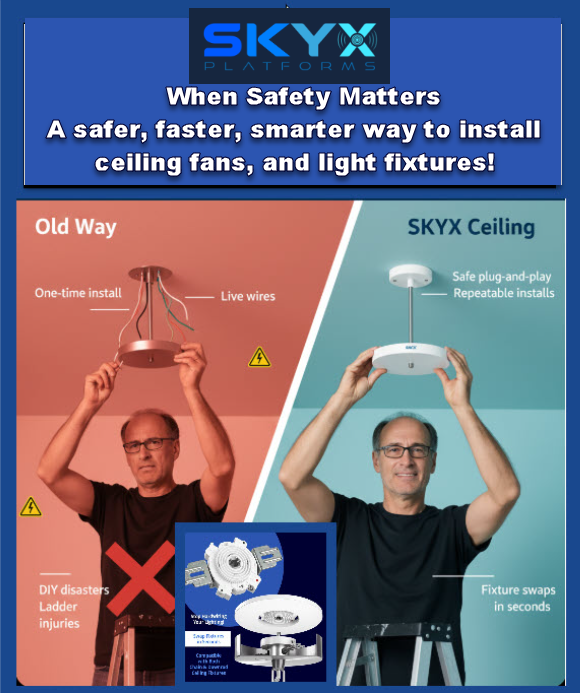
By Tim Weintraut | Alpha Wolf Impact | alphawolfimpact.com
In the first three articles, I covered the problem, the solution, and the proof. I showed you why the old way of wiring ceilings is outdated, why SKYX’s plug‑and‑play system matters, and the 10-year grind to getting into the NEC Code Book
This article is about something that, to me, is almost comical.
A billionaire real estate operator in France has already decided to make SKYX the standard across more than 250 hotels and buildings. Meanwhile, the country that got SKYX into the NEC, through ANSI, NEMA, UL, NFPA, AIA, and even in front of the CPSC, still struggles to say the obvious out loud: a mechanically engineered, plug‑and‑play ceiling platform that cuts ladder time and standardizes the connection is safer than twisting wires together in a box and hoping the wire-nut stays on.
And while that debate drags on, SKYX is quietly getting wired into hotels, apartments, prefab homes, luxury lakefront houses, smart cities, and mixed‑use developments across three continents.
The irony
The irony is hard to miss.
In the United States, SKYX has done the long, boring, serious work. The company’s ceiling receptacle platform has been written into the National Electrical Code under generic weight‑supporting language, advanced through ANSI and NEMA processes, aligned with UL and NFPA frameworks, presented to architects through an AIA course, and shown directly to CPSC staff with claims that it reduces installation difficulty, time on ladders, electrical hazards, and drop risks.
The CPSC meeting log is especially telling. SKYX showed videos of its installation process and told staff that the system reduces time on ladders, reduces electrical hazards, and improves the mechanical security of installed fans and fixtures. That matters because ladder falls remain one of the most common and serious jobsite hazards, especially in overhead trades.
So the U.S. safety and code ecosystem has effectively said, “Yes, this is a valid system.” But the language still stays dry, technical, and cautious. It doesn’t say in plain English what the platform is clearly doing: reducing ladder exposure, reducing live‑wire handling overhead, and replacing improvised field wiring with a mechanically engineered interface.
That’s where Europe enters the story.

Jean‑François Ott is not some fool
If you see “Group OTT” and assume it’s just another name in a small‑cap press release, you’re missing the point.
Jean‑François Ott is a French real estate entrepreneur with more than 30 years in the business, educated in finance and economics at Sciences Po Grenoble, with executive education at INSEAD. He founded Orco Property Group in Luxembourg in 1991 and built it into a major real estate platform in Central and Eastern Europe, with more than 200 assets totaling roughly 1.2 million square meters across multiple countries.
His track record includes hotel, residential, commercial, and logistics development, and he is credited with overseeing more than €3 billion in investments across more than 200 projects. He also navigated Orco through a major restructuring period, including the reworking of hundreds of millions of euros in debt. That tells you something important: this is not a tourist operator or lifestyle developer. This is someone who has survived real cycles, real stress, and real pressure in capital markets.
Today, through Group OTT and related entities, he is tied to a portfolio of more than 250 hotels and buildings across Europe, valued at over $4 billion. That matters because when someone like Ott makes a technology a brand standard, that is not a casual experiment. That is a capital allocation decision.
And that’s exactly what happened.
France: a billionaire makes SKYX the standard
In April 2026, SKYX and Group OTT announced a strategic partnership to deploy SKYX’s technologies as a brand standard throughout Group OTT’s existing and future hotels and buildings in Europe.
The language in the release matters:
While U.S. committees keep speaking in carefully neutral code language, a major European real estate operator has already looked at the economics, safety, and future‑proofing and said: "This is how we’re doing ceilings now."
 Marriott: proof inside a real hotel room
If Group OTT shows that a major European operator sees SKYX as a standard, the Marriott SpringHill Suites renovation shows what that standard looks like in the real world.
In 2025, SKYX demonstrated its technologies during a renovation at a Marriott SpringHill Suites hotel owned by the Shaner Group. During that demonstration, SKYX installed its advanced plug‑and‑play technologies throughout a guest room, including ceiling lighting, recessed lights, wall lights, EXIT and EMERGENCY lights, and plug‑in LED-backlit mirrors.
Hotels live on uptime and renovation cycles. A branded hotel does not care about clever tech for its own sake. It cares whether a room can be renovated faster, safer, and with less downtime. The Marriott SpringHill Suites demo showed that a real, brand‑name hotel room can be refit in minutes with less ladder time and less wiring exposure—exactly what the safety world has been talking about in theory.
So now the picture is stronger:
Group OTT proves portfolio‑level conviction.
Marriott proves room‑level execution in a brand‑name hotel.
Miami: a smart city chooses the platform
The U.S. side of the story is not weak. It’s just underappreciated.
SKYX announced that it is collaborating with a roughly $3 billion mixed‑use urban smart-home city project in Miami, in the Little River / Little Haiti area, and later company updates and calls frame the development as closer to $4 billion. The scale is enormous:

SKYX says its all‑in‑one smart home platform and plug‑and‑play technologies will be supplied across the project, and company materials indicate that more than 500,000 SKYX units are expected to be deployed into this smart city alone. If a multi‑billion‑dollar smart city is wiring its ceilings this way, that says something about where developers think the future is going.

North Carolina: a lakefront luxury community near Microsoft
In January 2026, SKYX announced it would supply its technologies to Lake Shore Reserve, a luxury waterfront smart‑home community on Lake Hickory in Granite Falls, North Carolina. The location matters because it sits within reach of a planned 1,385‑acre Microsoft campus expected to support data centers and future AI operations.
That’s not a one‑off demo house. That’s a serious residential community using the ceiling as a smart platform from day one, in the shadow of one of the world’s biggest tech companies.
 Texas: Landmark Companies scales it into multifamily
Texas is where the story gets especially concrete.
SKYX announced it will supply its technologies to a 278‑unit apartment project in Austin, Texas, built by Landmark Companies, with more than 10,000 SKYX units expected across ceiling lights, recessed lights, wall lights, EXIT and EMERGENCY devices, and mirrors. It also announced a separate 340‑unit development in San Antonio—88 townhomes and 252 apartments—again with Landmark Companies, where SKYX expects to deploy more than 15,000 units.
Together, that is more than 25,000 SKYX devices across two Texas multifamily developments with the same builder. Landmark is described as a developer with 27 years of experience, tens of thousands of units built across multiple states, and more than 3,000 units in development.
This shows SKYX moving beyond one‑off projects into repeat business with a scaled, experienced multifamily operator.

Prefab and factory housing: Cavco
The modular and manufactured housing side matters too.
SKYX announced a collaboration with Cavco Industries, a leading U.S. prefabricated home manufacturer, to integrate SKYX’s advanced plug‑and‑play ceiling technologies into its premium homes, including models featured in the NAHB International Builders’ Show Show Village. That means the product is not just being pitched to builders—it is being built into homes at the factory level.
That is how a new category becomes a standard. It moves from “interesting feature” to “default spec.”
Florida projects
Company updates also point to multiple developments in Florida.
SKYX says it is supplying more than 12,000 plug‑and‑play products into three projects by Forte Developments, including an 80‑story luxury tower in Brickell and developments in Clearwater Beach and Jupiter, Florida. Another 1,000‑unit mixed‑use development by Jeremiah Baron Companies is also slated to use SKYX’s platform.
That adds more evidence that this is not limited to a single geography or asset type.
The Middle East is the third continent
In October 2025, SKYX signed an agreement with Global Ventures Group, described as a prominent U.S. and international real estate developer, to deploy SKYX’s advanced smart home and smart building technologies into residential, commercial, and hotel projects across the Middle East, with a focus on Saudi Arabia and Egypt. Public coverage indicates the plan involves tens of thousands of homes and hotel rooms.
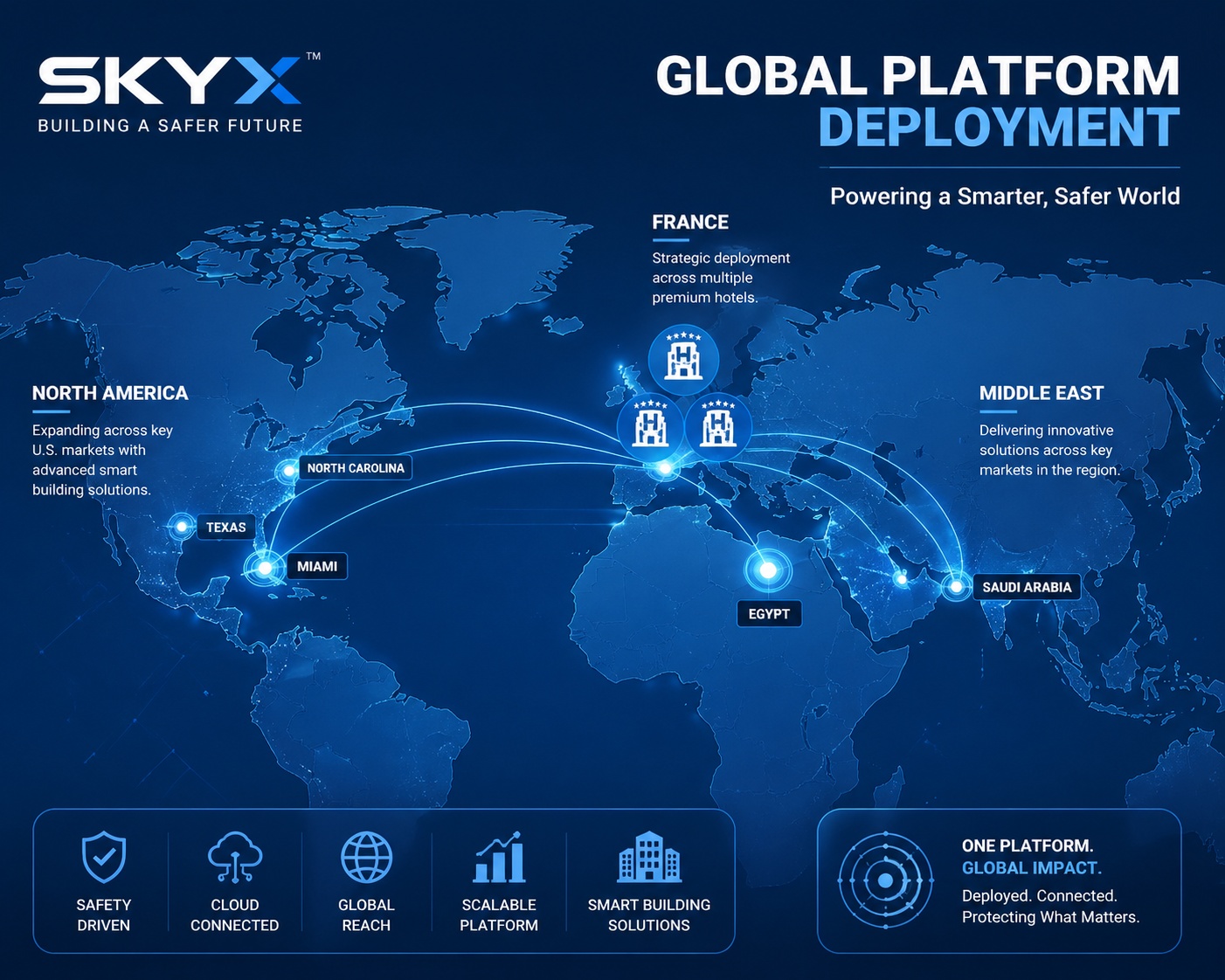
So now the footprint looks like this:
Distribution proves it is becoming a category
Projects matter, but distribution matters too.
SKYX products are now being launched through major retail channels, including Home Depot, Lowe’s, Walmart, and Target, with company releases and updates pointing to expanded placement of the All Seasons 3-in-1 SKYFAN, Turbo Heater, and related products across those platforms, both in‑store and online.
SKYX also owns and operates more than 60 lighting and home-décor e‑commerce websites, which the company uses to sell and promote its products directly and to educate buyers on installation simplicity, time savings, cost savings, and life‑safety benefits. On top of that, SKYX announced a strategic partnership with JIT Electrical Supply, a builder‑oriented supplier that has served more than 100,000 U.S. homes, to distribute SKYX products into professional channels.
That combination matters:
That is not what a fad looks like. That is what a new product category looks like when it starts locking into shelves, carts, and pro supply channels at the same time.
Architects and designers: Material Bank as the gatekeeper
There’s one more piece of the distribution puzzle that most retail investors have never heard of but every serious architect and designer knows: Material Bank.
Material Bank is a large B2B marketplace and logistics platform that connects architects, interior designers, and builders with hundreds of leading product brands and over 300,000 SKUs, delivering samples overnight from a centralized, highly automated warehouse network. It serves a community of more than 100,000–120,000 design professionals, letting them search across brands and order multiple material samples in one box, free for architects and designers.
In September 2023, SKYX signed an agreement with Material Bank, described as a world‑leading architect-focused product-material supply company with over 100,000 customers. Under that agreement:
SKYX will market its smart plug‑and‑play ceiling-platform products through Material Bank to architects, designers, and builders in both the commercial and residential segments.
SKYX is integrating its product line into its own 60+ lighting and home‑décor websites and bolstering that reach through Material Bank’s network of design professionals.
Analysts covering SKYX have called out Material Bank as access to the “gatekeepers”—the architects and designers who decide what actually goes into specifications and design packages. When those people can touch and sample a new ceiling platform next to established brands, that’s not a fad channel. That’s where the long‑cycle decisions get made.
What this really means
A billionaire developer in Europe makes SKYX his brand standard across more than 250 hotels and buildings. A Marriott SpringHill Suites renovation in the U.S. shows how quickly, safely, and simply we can work inside a real branded hotel room. A $3–4 billion smart city in Miami is wiring thousands of homes onto the platform. Landmark Companies in Texas put more than 25,000 devices into mainstream apartments. A luxury lakefront community in North Carolina near a major Microsoft AI campus, Florida towers, and mixed‑use projects, and a Middle Eastern pipeline of tens of thousands of homes and hotel rooms in Saudi Arabia and Egypt all chose the same plug‑and‑play ceiling-backbone.
That’s not a gadget story. That’s a platform quietly becoming part of the long‑term infrastructure stack on three continents, with distribution that now runs from Home Depot and Walmart to JIT Electrical and Material Bank, While the U.S. safety rulebook still struggles to say the WSCR is a mechanically engineered, plug‑and‑play ceiling system that slashes ladder time and wiring risk, and is obviously safer than twisting wires together in a box and hoping the wire-nut stays on.
Disclaimer
SKYX1-6 Series · Part 4 of 6
View full seriesSKYX Article 4: The World Gets It Before We Do
Meanwhile, the country that got SKYX into the NEC, through ANSI, NEMA, UL, NFPA, AIA, and CPSC, still hasn’t said in plain English what everyone can see — that this platform dramatically cuts ladder time and wiring risk and replaces “twist two wires and hope."
April 26, 2026
By Tim Weintraut | Alpha Wolf Impact | alphawolfimpact.com
In the first three articles, I covered the problem, the solution, and the proof. I showed you why the old way of wiring ceilings is outdated, why SKYX’s plug‑and‑play system matters, and the 10-year grind to getting into the NEC Code Book
This article is about something that, to me, is almost comical.
A billionaire real estate operator in France has already decided to make SKYX the standard across more than 250 hotels and buildings. Meanwhile, the country that got SKYX into the NEC, through ANSI, NEMA, UL, NFPA, AIA, and even in front of the CPSC, still struggles to say the obvious out loud: a mechanically engineered, plug‑and‑play ceiling platform that cuts ladder time and standardizes the connection is safer than twisting wires together in a box and hoping the wire-nut stays on.
And while that debate drags on, SKYX is quietly getting wired into hotels, apartments, prefab homes, luxury lakefront houses, smart cities, and mixed‑use developments across three continents.
The irony
The irony is hard to miss.
In the United States, SKYX has done the long, boring, serious work. The company’s ceiling receptacle platform has been written into the National Electrical Code under generic weight‑supporting language, advanced through ANSI and NEMA processes, aligned with UL and NFPA frameworks, presented to architects through an AIA course, and shown directly to CPSC staff with claims that it reduces installation difficulty, time on ladders, electrical hazards, and drop risks.
The CPSC meeting log is especially telling. SKYX showed videos of its installation process and told staff that the system reduces time on ladders, reduces electrical hazards, and improves the mechanical security of installed fans and fixtures. That matters because ladder falls remain one of the most common and serious jobsite hazards, especially in overhead trades.
So the U.S. safety and code ecosystem has effectively said, “Yes, this is a valid system.” But the language still stays dry, technical, and cautious. It doesn’t say in plain English what the platform is clearly doing: reducing ladder exposure, reducing live‑wire handling overhead, and replacing improvised field wiring with a mechanically engineered interface.
That’s where Europe enters the story.
Jean‑François Ott is not some fool
If you see “Group OTT” and assume it’s just another name in a small‑cap press release, you’re missing the point.
Jean‑François Ott is a French real estate entrepreneur with more than 30 years in the business, educated in finance and economics at Sciences Po Grenoble, with executive education at INSEAD. He founded Orco Property Group in Luxembourg in 1991 and built it into a major real estate platform in Central and Eastern Europe, with more than 200 assets totaling roughly 1.2 million square meters across multiple countries.
His track record includes hotel, residential, commercial, and logistics development, and he is credited with overseeing more than €3 billion in investments across more than 200 projects. He also navigated Orco through a major restructuring period, including the reworking of hundreds of millions of euros in debt. That tells you something important: this is not a tourist operator or lifestyle developer. This is someone who has survived real cycles, real stress, and real pressure in capital markets.
Today, through Group OTT and related entities, he is tied to a portfolio of more than 250 hotels and buildings across Europe, valued at over $4 billion. That matters because when someone like Ott makes a technology a brand standard, that is not a casual experiment. That is a capital allocation decision.
And that’s exactly what happened.
France: a billionaire makes SKYX the standard
In April 2026, SKYX and Group OTT announced a strategic partnership to deploy SKYX’s technologies as a brand standard throughout Group OTT’s existing and future hotels and buildings in Europe.
The language in the release matters:
- Group OTT has more than 250 buildings across Europe valued at over $4 billion.
- SKYX’s technologies are expected to reduce time and costs by up to 90% for hotel and building renovations and new builds.
- The deployment is framed not as a trial, but as a brand standard.
While U.S. committees keep speaking in carefully neutral code language, a major European real estate operator has already looked at the economics, safety, and future‑proofing and said: "This is how we’re doing ceilings now."
If Group OTT shows that a major European operator sees SKYX as a standard, the Marriott SpringHill Suites renovation shows what that standard looks like in the real world.
In 2025, SKYX demonstrated its technologies during a renovation at a Marriott SpringHill Suites hotel owned by the Shaner Group. During that demonstration, SKYX installed its advanced plug‑and‑play technologies throughout a guest room, including ceiling lighting, recessed lights, wall lights, EXIT and EMERGENCY lights, and plug‑in LED-backlit mirrors.
- The key point was not just that the products worked. It was how fast and how safely they worked.
- First‑time installation of the SKYX outlet into a standard box took about a minute.
- Once the outlet was in, fixtures could be plugged in within seconds instead of being wired one by one overhead.
- SKYX framed the demonstration around the safety, simplicity, time savings, and cost savings the platform delivered during the renovation.
Hotels live on uptime and renovation cycles. A branded hotel does not care about clever tech for its own sake. It cares whether a room can be renovated faster, safer, and with less downtime. The Marriott SpringHill Suites demo showed that a real, brand‑name hotel room can be refit in minutes with less ladder time and less wiring exposure—exactly what the safety world has been talking about in theory.
So now the picture is stronger:
Group OTT proves portfolio‑level conviction.
Marriott proves room‑level execution in a brand‑name hotel.
Miami: a smart city chooses the platform
The U.S. side of the story is not weak. It’s just underappreciated.
SKYX announced that it is collaborating with a roughly $3 billion mixed‑use urban smart-home city project in Miami, in the Little River / Little Haiti area, and later company updates and calls frame the development as closer to $4 billion. The scale is enormous:
- More than 5,700 condos and apartments
- Roughly 350,000 square feet of retail
- Over 100,000 square feet of office
- Around 1.5 million square feet of parks and paths
- A Tri‑Rail station and transit component
SKYX says its all‑in‑one smart home platform and plug‑and‑play technologies will be supplied across the project, and company materials indicate that more than 500,000 SKYX units are expected to be deployed into this smart city alone. If a multi‑billion‑dollar smart city is wiring its ceilings this way, that says something about where developers think the future is going.
North Carolina: a lakefront luxury community near Microsoft
In January 2026, SKYX announced it would supply its technologies to Lake Shore Reserve, a luxury waterfront smart‑home community on Lake Hickory in Granite Falls, North Carolina. The location matters because it sits within reach of a planned 1,385‑acre Microsoft campus expected to support data centers and future AI operations.
- The project calls for 140 luxury smart single‑family homes. SKYX expects to supply more than 10,000 units of advanced plug‑and‑play technologies into the development, including ceiling lights, fans, recessed lights, wall lights, EXIT and EMERGENCY lights, backlit mirrors, and an NVIDIA‑integrated smart home hub in every home.
That’s not a one‑off demo house. That’s a serious residential community using the ceiling as a smart platform from day one, in the shadow of one of the world’s biggest tech companies.
Texas is where the story gets especially concrete.
SKYX announced it will supply its technologies to a 278‑unit apartment project in Austin, Texas, built by Landmark Companies, with more than 10,000 SKYX units expected across ceiling lights, recessed lights, wall lights, EXIT and EMERGENCY devices, and mirrors. It also announced a separate 340‑unit development in San Antonio—88 townhomes and 252 apartments—again with Landmark Companies, where SKYX expects to deploy more than 15,000 units.
Together, that is more than 25,000 SKYX devices across two Texas multifamily developments with the same builder. Landmark is described as a developer with 27 years of experience, tens of thousands of units built across multiple states, and more than 3,000 units in development.
This shows SKYX moving beyond one‑off projects into repeat business with a scaled, experienced multifamily operator.
Prefab and factory housing: Cavco
The modular and manufactured housing side matters too.
SKYX announced a collaboration with Cavco Industries, a leading U.S. prefabricated home manufacturer, to integrate SKYX’s advanced plug‑and‑play ceiling technologies into its premium homes, including models featured in the NAHB International Builders’ Show Show Village. That means the product is not just being pitched to builders—it is being built into homes at the factory level.
That is how a new category becomes a standard. It moves from “interesting feature” to “default spec.”
Florida projects
Company updates also point to multiple developments in Florida.
SKYX says it is supplying more than 12,000 plug‑and‑play products into three projects by Forte Developments, including an 80‑story luxury tower in Brickell and developments in Clearwater Beach and Jupiter, Florida. Another 1,000‑unit mixed‑use development by Jeremiah Baron Companies is also slated to use SKYX’s platform.
That adds more evidence that this is not limited to a single geography or asset type.
The Middle East is the third continent
In October 2025, SKYX signed an agreement with Global Ventures Group, described as a prominent U.S. and international real estate developer, to deploy SKYX’s advanced smart home and smart building technologies into residential, commercial, and hotel projects across the Middle East, with a focus on Saudi Arabia and Egypt. Public coverage indicates the plan involves tens of thousands of homes and hotel rooms.
So now the footprint looks like this:
- Europe: Group OTT
- North America: Miami, North Carolina, Texas, Florida, Cavco
- Middle East: Saudi Arabia and Egypt via Global Ventures
- Hotels. Apartments. Luxury homes. Prefab housing. Smart cities. Mixed‑use developments.
Distribution proves it is becoming a category
Projects matter, but distribution matters too.
SKYX products are now being launched through major retail channels, including Home Depot, Lowe’s, Walmart, and Target, with company releases and updates pointing to expanded placement of the All Seasons 3-in-1 SKYFAN, Turbo Heater, and related products across those platforms, both in‑store and online.
SKYX also owns and operates more than 60 lighting and home-décor e‑commerce websites, which the company uses to sell and promote its products directly and to educate buyers on installation simplicity, time savings, cost savings, and life‑safety benefits. On top of that, SKYX announced a strategic partnership with JIT Electrical Supply, a builder‑oriented supplier that has served more than 100,000 U.S. homes, to distribute SKYX products into professional channels.
That combination matters:
- Big‑box retail for mainstream visibility
- A multi‑site e‑commerce network for breadth and control
- Electrical distribution for builders and contractors through JIT
That is not what a fad looks like. That is what a new product category looks like when it starts locking into shelves, carts, and pro supply channels at the same time.
Architects and designers: Material Bank as the gatekeeper
There’s one more piece of the distribution puzzle that most retail investors have never heard of but every serious architect and designer knows: Material Bank.
Material Bank is a large B2B marketplace and logistics platform that connects architects, interior designers, and builders with hundreds of leading product brands and over 300,000 SKUs, delivering samples overnight from a centralized, highly automated warehouse network. It serves a community of more than 100,000–120,000 design professionals, letting them search across brands and order multiple material samples in one box, free for architects and designers.
In September 2023, SKYX signed an agreement with Material Bank, described as a world‑leading architect-focused product-material supply company with over 100,000 customers. Under that agreement:
SKYX will market its smart plug‑and‑play ceiling-platform products through Material Bank to architects, designers, and builders in both the commercial and residential segments.
SKYX is integrating its product line into its own 60+ lighting and home‑décor websites and bolstering that reach through Material Bank’s network of design professionals.
Analysts covering SKYX have called out Material Bank as access to the “gatekeepers”—the architects and designers who decide what actually goes into specifications and design packages. When those people can touch and sample a new ceiling platform next to established brands, that’s not a fad channel. That’s where the long‑cycle decisions get made.
What this really means
A billionaire developer in Europe makes SKYX his brand standard across more than 250 hotels and buildings. A Marriott SpringHill Suites renovation in the U.S. shows how quickly, safely, and simply we can work inside a real branded hotel room. A $3–4 billion smart city in Miami is wiring thousands of homes onto the platform. Landmark Companies in Texas put more than 25,000 devices into mainstream apartments. A luxury lakefront community in North Carolina near a major Microsoft AI campus, Florida towers, and mixed‑use projects, and a Middle Eastern pipeline of tens of thousands of homes and hotel rooms in Saudi Arabia and Egypt all chose the same plug‑and‑play ceiling-backbone.
That’s not a gadget story. That’s a platform quietly becoming part of the long‑term infrastructure stack on three continents, with distribution that now runs from Home Depot and Walmart to JIT Electrical and Material Bank, While the U.S. safety rulebook still struggles to say the WSCR is a mechanically engineered, plug‑and‑play ceiling system that slashes ladder time and wiring risk, and is obviously safer than twisting wires together in a box and hoping the wire-nut stays on.
Disclaimer
I am not a financial advisor. This article is for informational purposes only and is not financial advice. I own shares of SKYX Platforms Corp. and may buy or sell at any time. This is not a paid promotion. I have consulted for SKYX in the past, but this relationship does not influence the content or opinions in this article. Always conduct your own research and consult a qualified financial professional before investing. Small-cap stocks carry significant risk.
← Previous in SKYX1-6 Series SeriesPart 3: SKYX Part 3: The Grind – A Decade of Codes, Standards, and Why the Language Still Sounds So TameNext in SKYX1-6 Series Series →Part 5: SKYX Article 5 Future Proof: The Building App Store
Join The Wave
Get Early Access & Exclusive Intel
The Watchlist. Full deep-dives. Monthly Wave Room. Early video access. Everything serious impact investors need — before the crowd catches on.
Free. Unsubscribe anytime. By subscribing you agree to our Privacy Policy.