Aurora Spine: The Scrappy Innovator Transforming Spine Surgery
Why This Company Caught My Eye Chronic back pain is one of the most pervasive health challenges in America. Over 80 million Americans deal with it, and for too many, the path to relief means navigating a fragmented, intimidating world of spine surgery options. When I started looking deeper into the

Chronic back pain is one of the most pervasive health challenges in America. Over 80 million Americans deal with it, and for too many, the path to relief means navigating a fragmented, intimidating world of spine surgery options. When I started looking deeper into the medtech space for companies actually solving this problem — not just iterating on it — one name kept surfacing.
I sat down with CEO Trent Northcutt and CCO Matthew Goldstone for an exclusive Alpha Wolf Impact interview to understand their 2026 growth strategy, the competitive moat they’re building, and why this company is worth serious attention from impact-minded investors. I’d encourage every reader to watch the full interview on the Alpha Wolf Impact YouTube channel — there’s depth in that conversation that no article can fully capture.
What Makes Aurora Spine Different: The DEXA Technology Platform
At the heart of Aurora Spine’s innovation is the DEXA Technology Platform — the world’s first bone density-matched spinal implant system. This isn’t incremental innovation. It’s a paradigm shift in how spine surgeons approach fusion procedures.
Here’s the core idea: every patient’s bone is different. A 55-year-old woman with osteopenia has fundamentally different bone quality than a 40-year-old man with healthy density. Yet until DEXA, surgeons were essentially using one-size-fits-all implants. Aurora Spine changed that.
“DEXA-C provides surgeons with the first tool that truly puts bone quality at the center of implant selection.”
— Trent Northcutt, CEO, Aurora Spine Corporation
The DEXA implants feature an open porous structure that mimics cancellous bone, matching the modulus of elasticity to each patient’s bone density. This means better integration, better outcomes, and less risk of implant subsidence — a persistent problem in traditional spine surgery.

DEXA-C — Cervical interbody device. 1,500+ successful surgeries
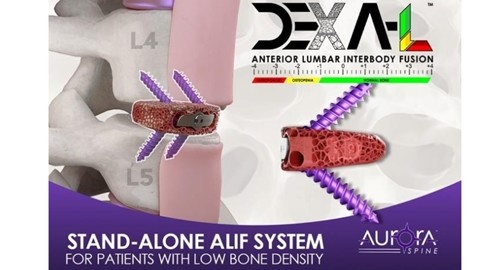
DEXA-L — Lumbar interbody fusion. Launched September 2025.
The Product Arsenal: More Than a One-Trick Pony
While DEXA is the headline, Aurora Spine has built a diversified product portfolio that addresses multiple segments of the spine market. This breadth is important — it reduces single-product risk and creates multiple revenue growth vectors.
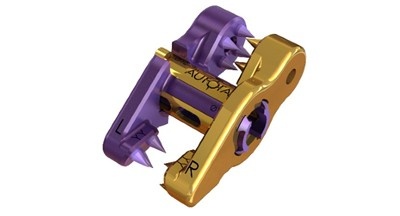
ZIP — Patented screwless interspinous fixation with ONE-STEP™ locking mechanism.
• ZIP: Patented screwless interspinous fixation with ONE-STEP™ locking mechanism. REFINE clinical study completed enrollment (March 2025). First US patent allowed.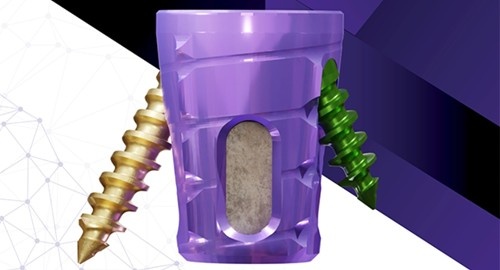
SiLO TFX — Sacroiliac joint fusion. 2,500+ procedures performed.
• SiLO TFX: Sacroiliac joint fusion system. 2,500+ procedures. Published biomechanical study demonstrating superiority over traditional posterior techniques (April 2025). Generates $2M+ per quarter.The importance of this cannot be overstated. Previously, Aurora Spine was purchasing third-party biologics to pair with their implants. By bringing biologics in-house, CCO Matthew Goldstone told us in our interview that the company expects a 30% margin improvement and a 90% logistics cost reduction. Those are transformational numbers for a company at this stage.
• TURBO FUSE: 100% allograft demineralized bone fiber putty for fusion support
• OSTEO GRAFT: DBM putty formulated for bone fusion support in spinal procedures
• OSTEO BRIDGE: Sponge strips for bridging bone voids during fusion
This move positions Aurora Spine as a full-ecosystem provider — surgeons can now source both the mechanical implant and the biologic graft material from a single vendor, simplifying procurement and strengthening customer relationships.
For a deeper dive into Aurora Spine’s biologics strategy, read the full biologics article on the Alpha Wolf Impact website.
The Numbers: Financial Snapshot
For a microcap medtech, Aurora Spine’s financial trajectory tells a compelling story of a company crossing critical milestones — from revenue consistency to positive EBITDAC to margin expansion.Gross Margin (Q3 2025) 60.9% (Q2 2025: 62.2%)
EBITDAC (Q3 2025) $165K — Positive 2 consecutive quarters
Revenue Growth FY2024 20.95% year-over-year
Cervical Revenue (Q2 2025) ~$800K — Up 70% vs. prior year
October 2025 Record revenue month in company history
Debt ~$2.8M
Shares Outstanding 78M
Source: GlobeNewswire Q3 2025 Earnings Release (November 18, 2025). 9-month 2025 cumulative sales up $485K vs. prior year.
The 2026 Game Plan: From R&D to Scale
2. Disposable procedural sets — Transitioning from reusable to disposable instrument sets for hospital scalability. This removes a major logistical bottleneck and makes it easier for new hospitals to adopt Aurora Spine products.
3. Third-party to proprietary conversion — Converting purchased products to in-house manufacturing, including the biologics line, driving significantly higher margins.
4. Clinical data publication — Peer-reviewed studies on ZIP (REFINE) and DEXA are in progress, building the evidence base that hospital value committees demand.
5. Pain interventionalist market penetration — There are six pain doctors for every one spine surgeon in the US. Aurora Spine is targeting this massive, underpenetrated market with products like SiLO TFX and ZIP.
6. Hospital approval momentum — Following the January 2026 Lytham Partners Healthcare Summit, management reported the limited launch phase is expanding, hospital approvals are growing, and a Q1/Q2 2026 revenue uptick is expected.
7. Eventual OTC uplisting — Management has indicated they are targeting an eventual uplisting from OTC markets, which would unlock institutional investor access and significantly expand the shareholder base.
The Alpha Wolf Impact Thesis: Why This Company Matters
• Patient Outcomes: Less invasive procedures mean faster recovery, reduced pain, and patients returning to their lives sooner. Every surgery using DEXA technology is personalized to the patient’s bone quality.
• Healthcare Economics: Shorter hospital stays, lower complication rates, and reduced revision surgeries. Minimally invasive technology directly lowers the cost burden on the healthcare system.
• Innovation Leadership: Setting new standards with bone-density matching technology. The DEXA platform is a first-of-its-kind approach that the rest of the industry will eventually have to follow.
• Community Ripple Effect: Better spine health means people back to work, back to their families, back to productive lives. Job creation through expanding R&D and sales teams amplifies the economic impact.
This is what impact investing looks like in practice. It’s not just a stock play — it’s a company solving a massive health problem that affects tens of millions of Americans. When the financial thesis and the human thesis align this closely, I pay attention. And I think you should too.
Watch the Full Interview
Get the complete story directly from CEO Trent Northcutt and CCO Matthew Goldstone — including details on clinical data, competitive positioning, and the 2026 revenue outlook. Watch the full interview on the Alpha Wolf Impact YouTube channel.For an even deeper dive into Aurora Spine’s biologics strategy, read the full From Metal to Biology article on alphawolfimpact.com. And sign up for Alpha Wolf Impact alerts to stay informed on future Impact Stock deep dives.
Disclaimer: This article is for informational purposes only and does not constitute financial advice. Alpha Wolf Impact is not a registered investment advisor. Always conduct your own due diligence and consult with a qualified financial professional before making any investment decisions. Investing in microcap stocks involves significant risks, including the potential loss of your entire investment.
ALPHA WOLF IMPACT
Highlighting companies with large positive impact beyond stock picking.
www.alphawolfimpact.com
Published March 2, 2026
Get Early Access & Exclusive Intel
The Watchlist. Full deep-dives. Monthly Wave Room. Early video access. Everything serious impact investors need — before the crowd catches on.
Free. Unsubscribe anytime. By subscribing you agree to our Privacy Policy.