One Company, One Ceiling, One Spark = Revolutionizing an Industry
How SKYX Platforms Shows What Alpha Wolf Impact Really Looks Like
What do I mean by that? I hunt for businesses that solve real problems — companies whose products make us safer, more efficient, cut risk, protect the environment, or even save lives.
I look for logical solutions that make sense. The kind of ideas that can reset an industry and move humanity forward, leaving a positive mark that lasts for generations. Someone once said that if you want more out of life, try to be just a little bit better than you were yesterday. Now imagine that mindset at a global scale. Imagine if every day, all of us asked: how can I be better — and how can we make the world better — today?

That’s exactly where SKYX Platforms steps in.
The Quiet Emergency Hiding Above Our Heads
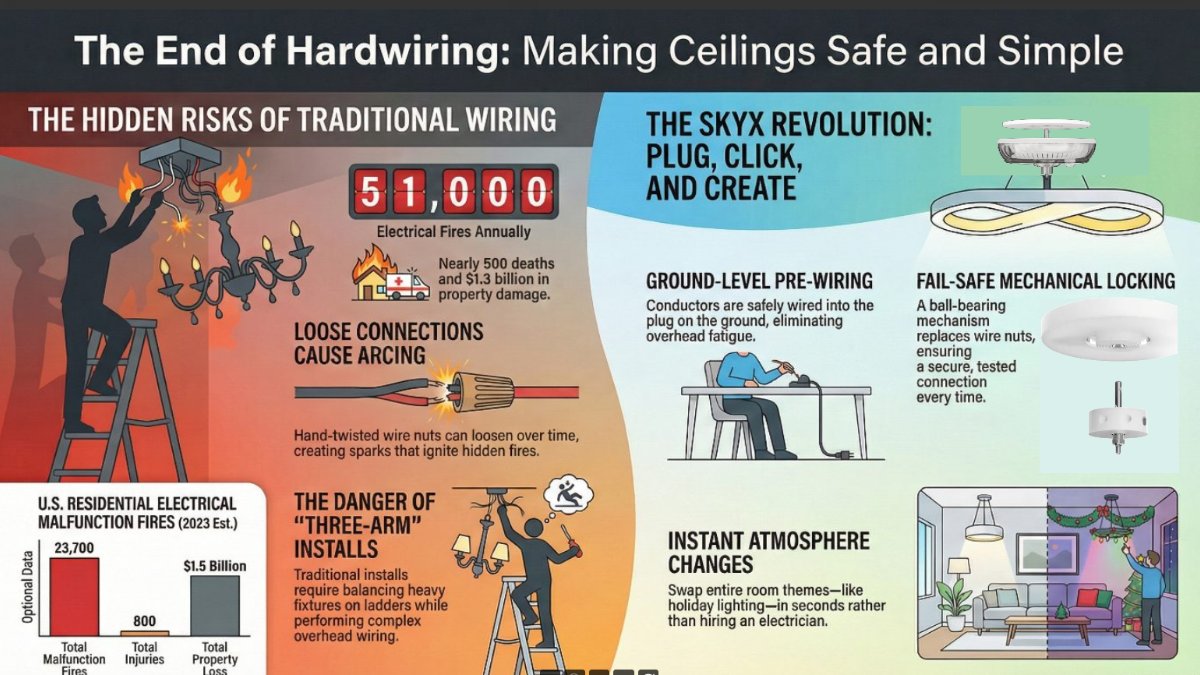
That’s the backdrop: Now drop SKYX Platforms into that picture. This is what Alpha Wolf Impact looks like in the real world — one company, one ceiling, one spark.
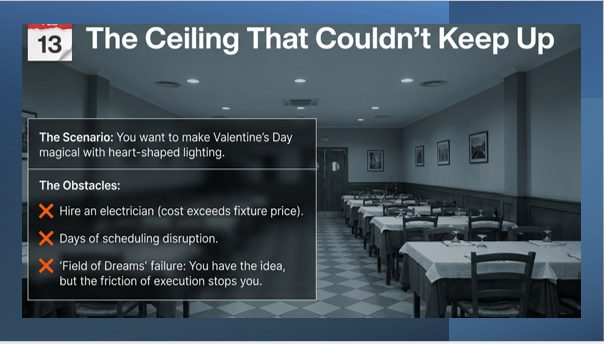
But your ceiling fixtures are hardwired and stubborn. To change them, you’d have to:
Hire an electrician, often paying as much or more than the fixtures themselves.
So year after year, you give up. The food is fantastic. The room is fine. But it never looks like the experience in your head.
Now imagine the same restaurant after upgrading to SKYX plug-and-play ceiling receptacles.
It’s 4 p.m. on February 13th. You and your staff walk in with a box full of heart-themed pendant fixtures. You climb a ladder, press a button, and pop each existing fixture is down in seconds. Hand them to your employee like you’re passing plates. You grab long-stem pendant lights with a heart-shape and a rose on the bottom, ruby-red glass and a soft warm LED glow — just enough light for couples to read the menu, but low enough to turn the whole ceiling into a romantic canopy. Each fixture plugs into a mechanical ceiling receptacle that locks it in place. No wire nuts. No exposed live wires. No electrician. It takes about thirty seconds per fixture. By 5:30 p.m., the entire restaurant has transformed. Soft red and white hearts glow over every table. Couples take pictures. They post on social. They tell friends. They pre-book next year. The night becomes a story they share, not just a meal they ate.
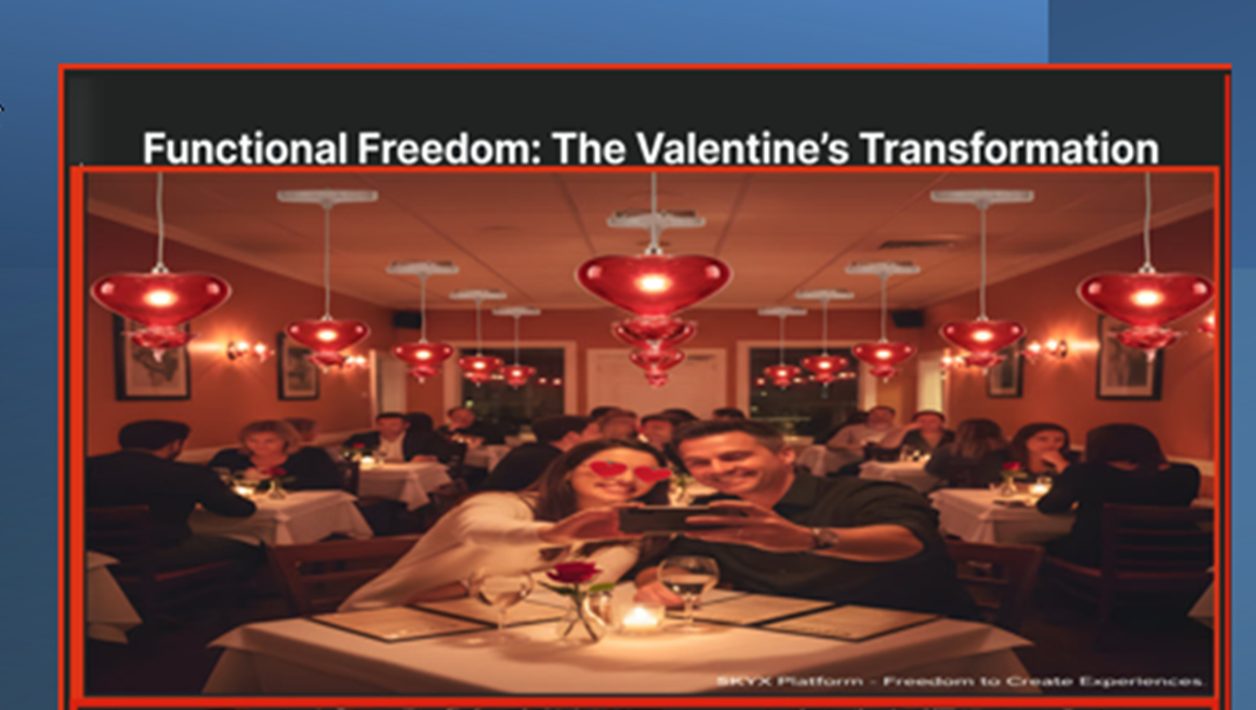
On February 15th, you spend 15–20 minutes swapping everything back. No downtime. No torn-up ceilings. No regrets. That is freedom to create experiences. The power to change a space without fear, friction, or a three-hour date with a ladder. That’s the emotion SKYX’s platform unlocks.
But under that emotion is something even bigger: SAFETY.
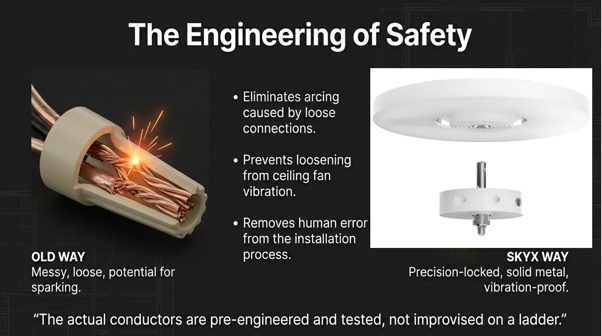
Right now, most ceiling fixtures are wired the old-fashioned way: on a ladder, by hand, with wire nuts twisted together and jammed into a metal junction box. Over time, those connections can loosen from fan vibration, heat cycling, corrosion, or just bad installs. Loose or failing connections can create arcing — tiny, high-energy electrical jumps that heat up nearby material until it eventually ignites. National fire data has repeatedly pointed to wiring defects and connection failures as a major source of residential electrical fires.
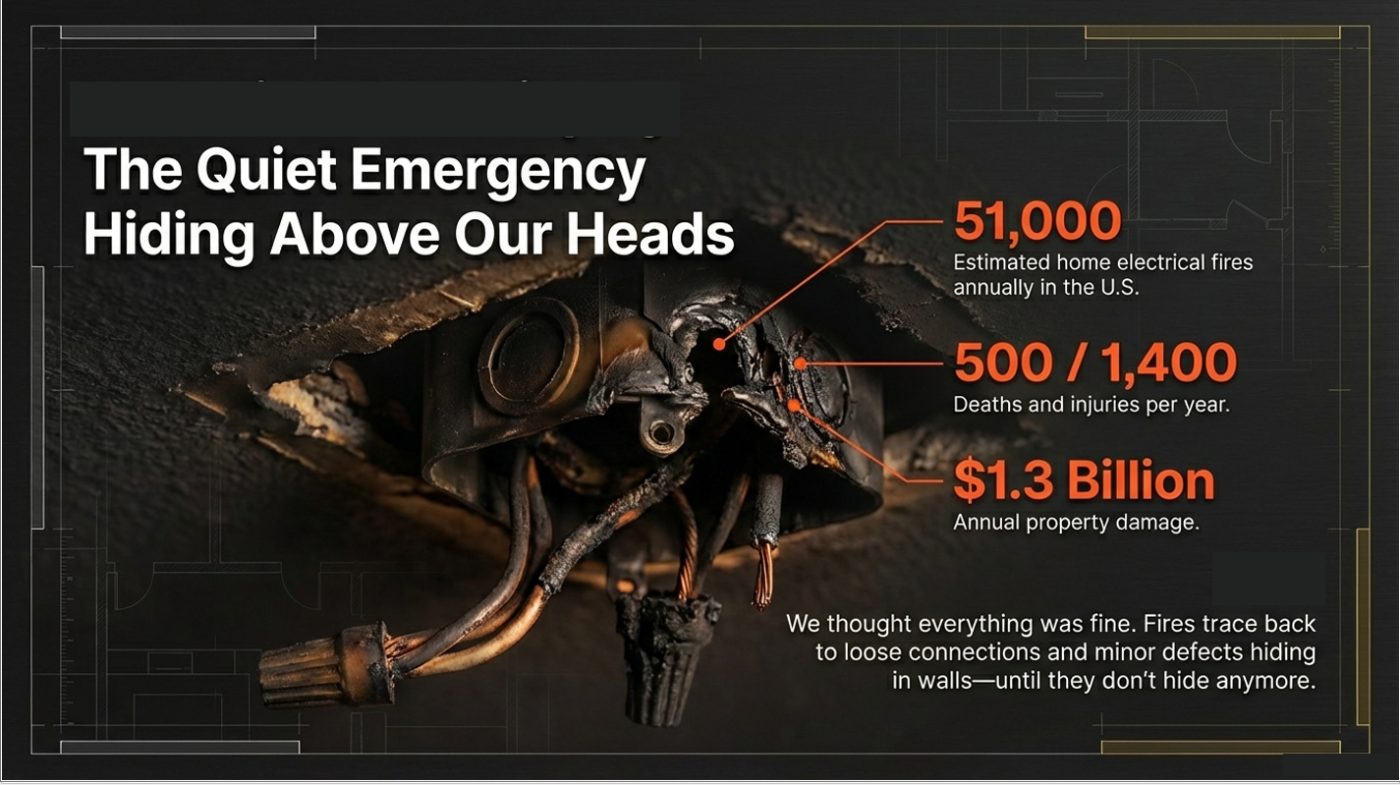
When that kind of failure lives in a ceiling, you get:
- Hidden smoldering in insulation or wood
- Slower smoke detection
- Faster involvement of the structure once it lights up
So the real question becomes:
Why are we still hanging fixtures with a 100-year-old method we know can fail, when we finally have smarter, safer hardware for the ceiling?
The Old Way vs. The SKYX Way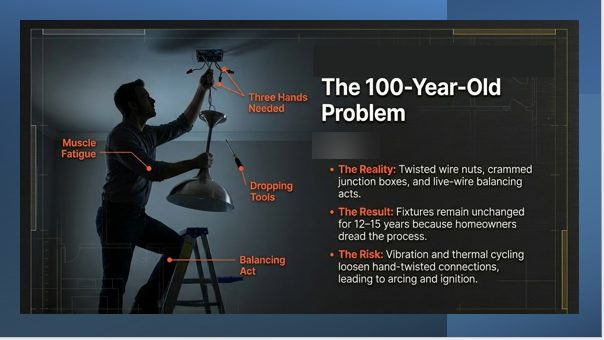
Hire an electrician, or drag out a ladder and try to be a gymnast and an electrician at the same time.
You climb up, balance a ceiling fan or light with one hand while wires are hanging out of the junction box. With the other hand, you twist bare copper together, cap it with wire nuts, and stuff everything back into the box. All while your arms burn, your shoulders shake, and you’re hoping nothing pulls loose when you finally mount the fixture.
Then you climb down, flip the breaker back on, and hit the switch. If nothing happens, you get to reverse the whole process and do it again. If it’s a fan and it wobbles, you’re chasing balance issues on top of wiring. I’ve been there. I’ve installed more fixtures than I can count over the years. I’ve been shocked because a breaker panel was mislabeled. I’ve had to drop a fixture mid-install because my arms gave out. I’ve fallen off a ladder. I’ve dropped wire nuts, screwdrivers, screws, and Allen wrenches — each one meaning another trip up and down. Changing ceiling fixtures is one of those honey-do jobs people avoid, not because they love the old fixtures, but because it’s a pain, it’s risky, and you almost need a third arm to pull it off. That’s a big reason many fixtures stay in place for 12–15 years: not because they’re perfect, but because swapping them is a hassle. Go to a big-box store, read the directions on a ceiling fan box, and you’ll see it: if you know what you’re doing, plan on 45–60 minutes; if you don’t, expect 2–3 hours.
Now here’s the SKYX way.
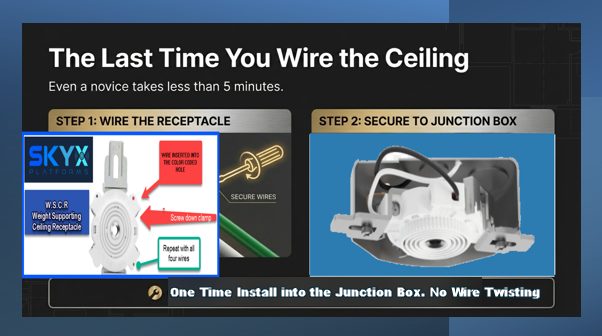
SKYX’s platform is built around a weight-supporting ceiling receptacle (W.S.C.R.) and a matching plug on the fixture side.
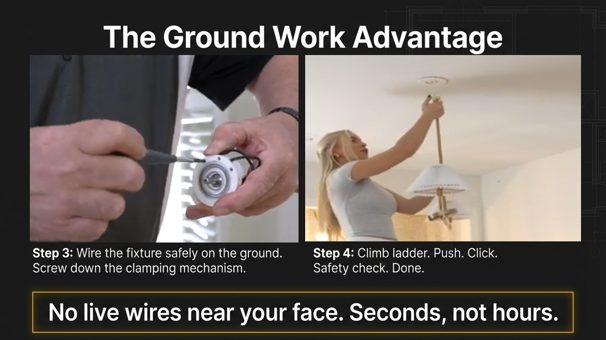
Step 3: You take the fixture — light, fan, or smart device — and wire its leads into the matching plug end, again on the ground, with color-coded ports and built-in clamps. Maybe you also attach a downrod or adjust a chain length while you’re at it. You’re doing this at chest height, not on a ladder.
Step 4: You climb the ladder, press a button on the fixture side, and push the center pin into the center of the ceiling receptacle. When you hear the click, you release the button. Give it one more push to double-check that it’s locked. If you hear the second click, you’re set. You just turned what used to be a 45–180 minute electrical job into a 5–7 minute setup and a lifetime of 30-second swaps. No live-wire contact. No improvised connections on a ladder. No “I hope that wire nut holds” stuffed into a metal box overhead.
ANSI & NEMA Certified, 10 additions to the NEC Electrical Code Book
What SKYX Really Moves: Risk, Time, and Imagination
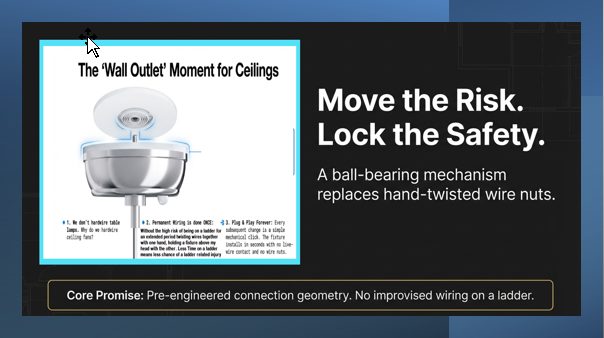
The magic of SKYX isn’t just the plug-and-play ceiling. It’s where the risk and effort go.
With the old way:Connections are improvised, overhead, and done under fatigue.
Loose or poor connections can become ignition sources for electrical fires.
Ladder time multiplies the chance of falls and injuries.
Live wires are never exposed at the ceiling once the receptacle is installed.
Most of the “work” happens on the ground, not at the top of a ladder.
Fixture swaps become a design choice, not a safety project. You’re attacking known failure points — loose connections, bad installs, extended ladder time — with a simple, logical platform.
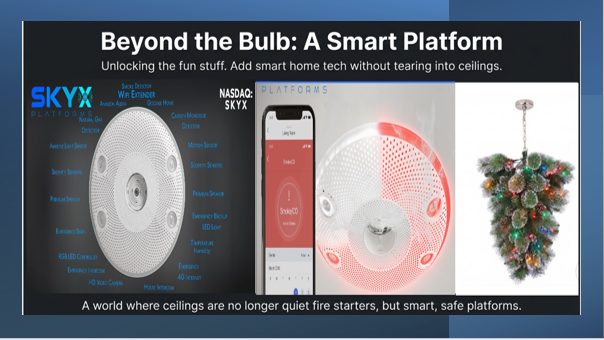
And then you unlock the “fun” side:
Plug-and-play smart hubs, sensors, and lighting without tearing into drywall.
Landlords, hotels, restaurants, and homeowners can rethink ceilings as flexible, living parts of the space.
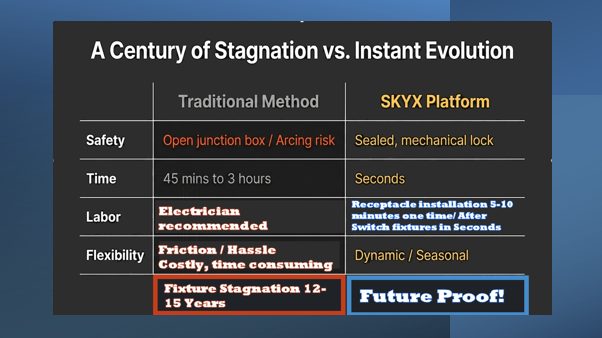
An Alpha Wolf movement isn’t built on fun alone. It’s built on real-world stakes and real-world proof. SKYX is a small company taking a direct shot at a quiet, deadly problem over our heads — and doing it in a way that could scale across millions of ceilings.
This first piece is about the “why”: the hidden risk in the ceiling and the common-sense fix. Stay tuned for part two of a seven part series on SKYX and why they matter!
Get Early Access & Exclusive Intel
The Watchlist. Full deep-dives. Monthly Wave Room. Early video access. Everything serious impact investors need — before the crowd catches on.
Free. Unsubscribe anytime. By subscribing you agree to our Privacy Policy.